
Specs are compiled from manufacturer listings and verified buyer reviews and can change over time — please confirm the key details on the product page before buying.
If you have ever peeled off a pair of compression socks halfway through a shift because your toes went numb, you already know the real problem with this category. It is almost never the pressure level on the label. It is the fit at the ankle, the length at the calf, and whether the fabric actually holds up past the second wash. Get those three right and 20-30 mmHg feels like support. Get them wrong and it feels like a tourniquet.
This guide is built by comparing the manufacturers’ published specifications and the patterns across verified customer reviews, so you get each pick’s real strengths and trade-offs instead of marketing spin.
Nine pairs below all deliver the same 20-30 mmHg pressure (a medical-grade squeeze that pushes blood back up your legs). Because the pressure class is identical, your real choice depends on fabric, length, sizing range, and how the sock holds up after a long day. This breakdown of 20-30 mmhg compression socks sorts them by what each pair actually does well, not by brand hype.
Top Picks


How To Choose The Best 20-30 Mmhg Compression Socks
Start with your calf, not your shoe size. Measure the widest part of your calf and match it to the brand’s chart before you look at anything else. A sock that is right at the ankle but too narrow at the calf will roll down and bunch behind the knee, and that bunching is the thing that makes people give up on compression altogether.
What mmHg really controls
The mmHg figure is a pressure reading in millimeters of mercury, and the range tells you how hard the sock squeezes. In a 20-30 mmHg sock, the tightest point sits at the ankle and the pressure eases as it climbs toward the calf. That fade is what helps move blood upward instead of pooling it at the foot. Every pair here sits in that same class, so the pressure number is your floor, not your deciding factor.
Calf sizing and wide-calf options
This is where most returns happen. Some brands size on calf circumference in inches with a matching shoe-size range, while others run a single stretch-to-fit design. If your calf measures toward the top of a chart, look for a pair that names a wide-calf fit or lists a calf range that goes past 18 inches. A sock labeled one-size rarely lands cleanly on a larger calf.
Fabric: cotton versus nylon and spandex
Cotton blends feel softer and breathe differently against the skin, while high-spandex blends hold their grip and stay up longer. Nylon-heavy socks tend to dry faster after a wash. There is no single winner — cotton suits people who find synthetics clammy, and spandex-rich knits suit people who are tired of tugging a sock back up.
Length, toe style, and when you will wear them
Knee-high is the standard for travel and long shifts because the compression runs the full lower leg. Open-toe designs let you check toe color and fit easily, which matters if you wear them daily. Closed-toe feels more like a regular sock under a shoe. If you plan to wear them on flights, knee-high with a firm top band is the usual pick.
Side-by-Side Comparison
| Model | Best For | Compression | Length | Fabric / Fit Note | Amazon |
|---|---|---|---|---|---|
| McNick & Company Men’s Copper (3 Pairs)★ Best Overall | Air travel and long work days | 20-30 mmHg | Knee high, 21 inches | Copper-infused, one-size-fits-all | Amazon |
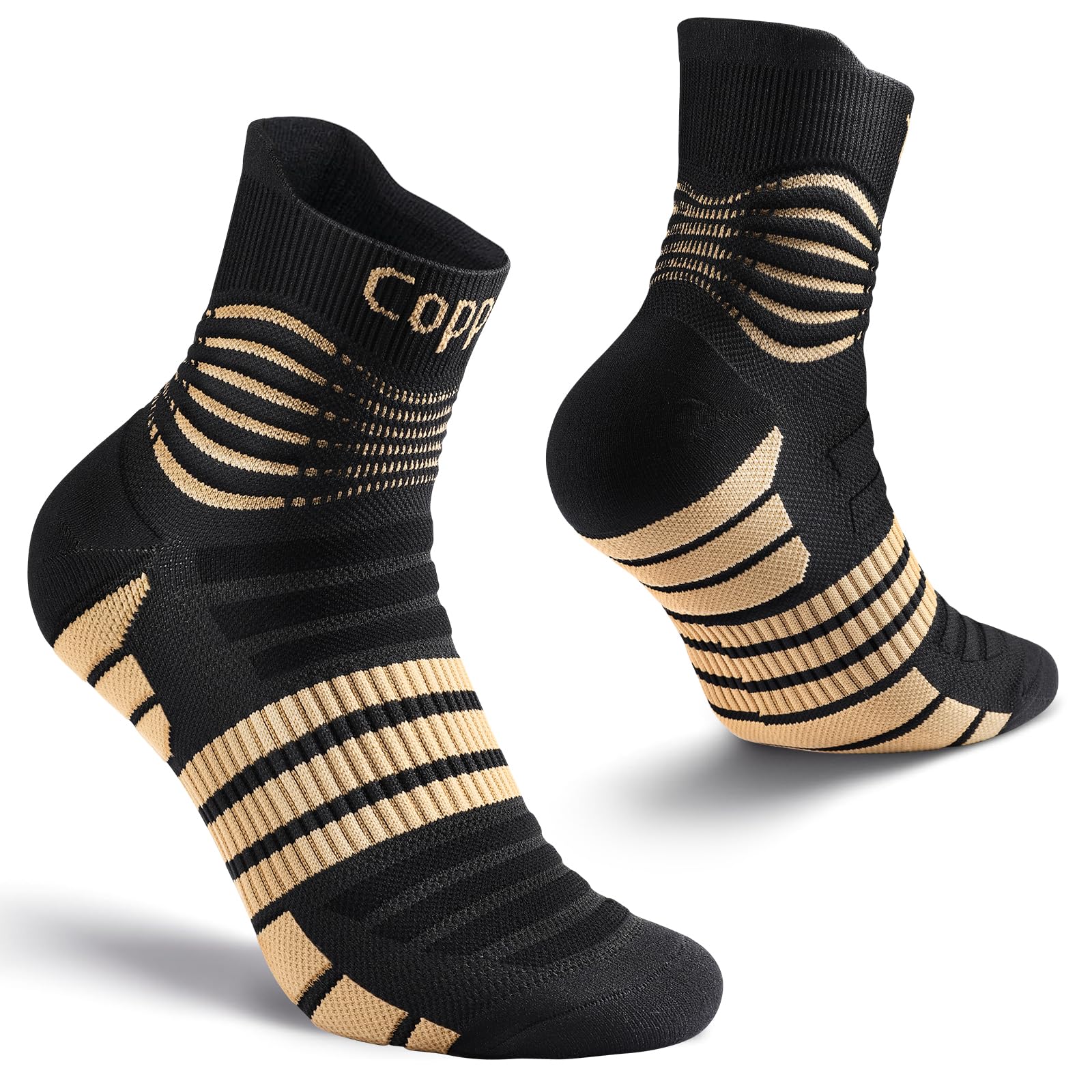
| NEENCA Professional Compression SocksBest Copper Blend | All-day circulation support | 20-30 mmHg | Low cut | 24% copper ions, 62% nylon, 14% spandex | Amazon |
| Physix Gear Compression SocksMost Reviewed | Shin splints and swelling relief | 20-30 mmHg | Knee high | Synthetic blend, runs big | Amazon |
| Compression Socks for Women&Men Graduated | Colour variety and easy on-off | 20-30 mmHg | Knee high | 85% nylon, 15% polyester | Amazon |
| Truform Compression Stockings | Class II medical-grade support | 20-30 mmHg | Knee high, closed toe | Everyday legwear look | Amazon |
| SB SOX Compression Socks | Wide calf and pregnancy | 20-30 mmHg | Knee high | 80% nylon, 20% spandex, calf-sized | Amazon |
| Momcozy Compression Socks | Pregnancy swelling | 20-30 mmHg | Knee high | Women’s fit, wide calf friendly | Amazon |
| VIM & VIGR Cotton Compression Socks | Breathable cotton feel | 20-30 mmHg | Knee high | 48% cotton, 42% nylon, 10% spandex | Amazon |
| JOBST Relief Knee High | Open-toe daily wear | 20-30 mmHg | Knee high, open toe | Smooth knit, regular band | Amazon |
Detailed Reviews
1. McNick & Company Copper Compression Socks
Our pick — 4.5+★ from 950+ verified ratings; the strongest balance of quality and price.
Three pairs of copper-knit knee-highs that cover a work week of long days on your feet.
What you get here is a 21-inch knee-high sock, which means the graduated squeeze runs the full length from your ankle up past the calf. That length is the reason these work for flights and for standing shifts alike — the pressure has room to taper instead of cutting off in a band at mid-calf. Copper fibers run in rows through the knit, and that is the feature the brand hangs its pitch on.
Owners describe these as firm without being punishing at the ankle, and easy enough to pull off at the end of the day. The fit is deliberately stretch-to-fit rather than sized to a calf measurement, so a very wide or a very narrow calf is the one buyer who should look elsewhere.
Price-tier wise this is a mid-range three-pack, and the value math is straightforward: you get rotation, not a single pair you wear two days in a row. Compare it to the NEENCA pair and the two land on opposite ends of a scale — the McNick three-pack weighs 7.36 ounces per the package listing, while the NEENCA pair comes in at 3.53 ounces. That difference is fabric density you can feel in the hand, and it is the reason the McNick knit holds a firmer line through the day while the NEENCA feels thinner and more breathable.
What earns the top spot
- 21-inch knee-high length gives the compression room to taper properly
- Three pairs means daily rotation without constant laundry
- Copper fiber knit holds shape and color after repeated washes
- Knee-to-toe coverage suited to air travel and long standing shifts
Where it asks you to compromise
- One-size-fits-all design, so calf measurement is not part of the fit
- Denser knit runs warmer than a thin synthetic pair
Reach for this if: you want a knee-high that covers the whole lower leg and you would rather rotate three pairs than baby one.
Look elsewhere if: your calf runs far above or below average — a calf-sized sock will land closer.
2. NEENCA Professional Compression Socks
A low-cut copper sock built around the ankle, not the calf.
The number that defines this pair is 24% — that is the share of copper ions infused into the fiber, alongside 62% nylon and 14% spandex. Six compression rings wrap the ankle by design, and the sole carries six-layer thicker loops meant to cushion impact points. If swelling sits low at your ankle and foot rather than up your calf, that layout is aimed directly at you.
This is the lightest build in this group at 3.53 ounces, and the air-knit fabric is meant to wick and dry fast. In practice that reads as a sock you forget you are wearing, especially under a shoe. The trade-off is the low cut: there is no knee-high column of compression here, so if you want pressure running up the calf for a flight, this is the wrong shape.
The sizing is the other thing to handle carefully — the brand points you to its own chart and warns you to check it. Buyers who match the chart tend to land well; a mismatched calf is where the fit complaints start. Pick this when ankle-level support and a slim profile matter more than full-leg coverage.
The honest read: a targeted ankle-and-foot sock with a genuinely unusual copper content, best for low swelling and daily shoe wear rather than full calf compression.
Fits your day if: your swelling lives at the ankle and you want the thinnest, lightest pair on this list under a normal shoe.
Pass it by if: you need the knee-high column — this one stops low by design.
3. Physix Gear Compression Socks 20-30 mmHg
The knee-high that runners and nurses keep coming back to for shin and calf relief.
By sheer volume of feedback, this is the pair with the deepest track record in this group — the quality of the knit is what people talk about first, and by a wide margin. The sock is built to hold a snug graduated squeeze across the arch and heel while staying soft enough to wear through a shift. Reviewers repeatedly credit it with easing shin splint pain and neuropathy discomfort, which fits a firm 20-30 mmHg squeeze.
Now the honest part. The sizing runs big, and buyers with larger calves report it is not the best match — this is a sock that rewards a careful read of the chart, not a guess. Getting it on and off draws a genuine split in feedback too: some find it quick, others find the firm knit takes a tug. Neither is a defect, but both are things to know before you buy.
Against the McNick three-pack above, this is a single pair with a much firmer following on shin-splint relief specifically. If your goal is post-run recovery rather than travel comfort, this one leads on that job.
Why people keep buying it
- Firm graduated squeeze across arch and heel
- Deep track record specifically on shin splint and calf relief
- Knee-high build suited to running, nursing shifts, and travel
Read the chart twice
- Sizing runs big — order carefully against the chart
- Reports say it is not the best fit for large calves
- Pulling the firm knit on and off draws mixed reactions
Worth buying for: runners and shift workers who want a firm knee-high and will size it properly from the chart.
Think twice if: you have a large calf or you want a sock that slides on with zero effort.
4. Compression Socks 20-30 mmHg

A soft nylon knee-high that goes on without a fight and comes in colours you will actually wear.
The fabric is the story: 85% nylon and 15% polyester, knit to be breathable and moisture-wicking. That blend is why these slide on easily and feel soft against the leg all day. The graduated 20-30 mmHg profile runs ankle to knee, aimed at the usual suspects — nurses on their feet, travellers on long hauls, athletes after a session, and pregnant women dealing with heavy legs.
What buyers notice most is how easy they are to put on and take off, and how the colours look once they are on. That ease is genuinely useful if you are new to compression and do not want a wrestling match every morning. The flip side is that softer, easier-on knits tend to feel less assertive than a firm spandex-heavy sock — you are trading a little grip for a lot of comfort.
Compared to the Physix Gear pair, this is the gentler end of the family. Same pressure class, a far more forgiving pull-on.
Where it lands: the friendly entry into daily compression wear — soft, easy, and good-looking, with a mild squeeze rather than an iron grip.
Choose it for: a first compression sock you will actually keep wearing, especially if morning dressing is a chore.
Skip it for: maximum firmness under heavy swelling — the soft blend trades some grip for comfort.
5. Truform 20-30 mmHg Compression Stockings

The one that looks like ordinary legwear but carries a Class II medical registration.
Here is the distinction worth understanding: Class II compression is registered with the FDA and carries a verified graduated pressure profile, unlike Class I general-use wear. Truform builds these in its own FDA-registered factory, and the brand has been in medical manufacturing out of Ohio since 1893. If you want a sock that reads as everyday legwear rather than athletic gear, this closed-toe knee-high does that well.
Reviewers praise its compression strength above all, and it delivers on swelling. The fit is the split point — buyers who measure carefully describe a roomy toe box and an all-day hold, while those who guess report it comes up tight. Truform publishes a four-step donning method (inside-out to the heel, then roll up gradually, smooth out folds, and remove by turning it inside out), and following it makes a real difference on a proper medical-grade knit.
The durability question is fair to raise: these stay put through a long day, but the feedback wishes they held up better over time. That is a normal trade for a sock this firm, and it is the reason a careful wash routine is worth building.
Why it earns a premium label: a verified medical-grade profile and an everyday look are a rare combination, and the Class II registration is the real differentiator here.
The fair caveat: measure before you order and expect to follow the donning steps — a guessed size is where the tightness complaints begin.
Built for: buyers who want a registered medical-grade sock that passes as normal legwear at the office.
Not for: anyone who wants to eyeball a size and go — this one needs the tape measure.
6. SB SOX Compression Socks for Men & Women (20-30mmHg)
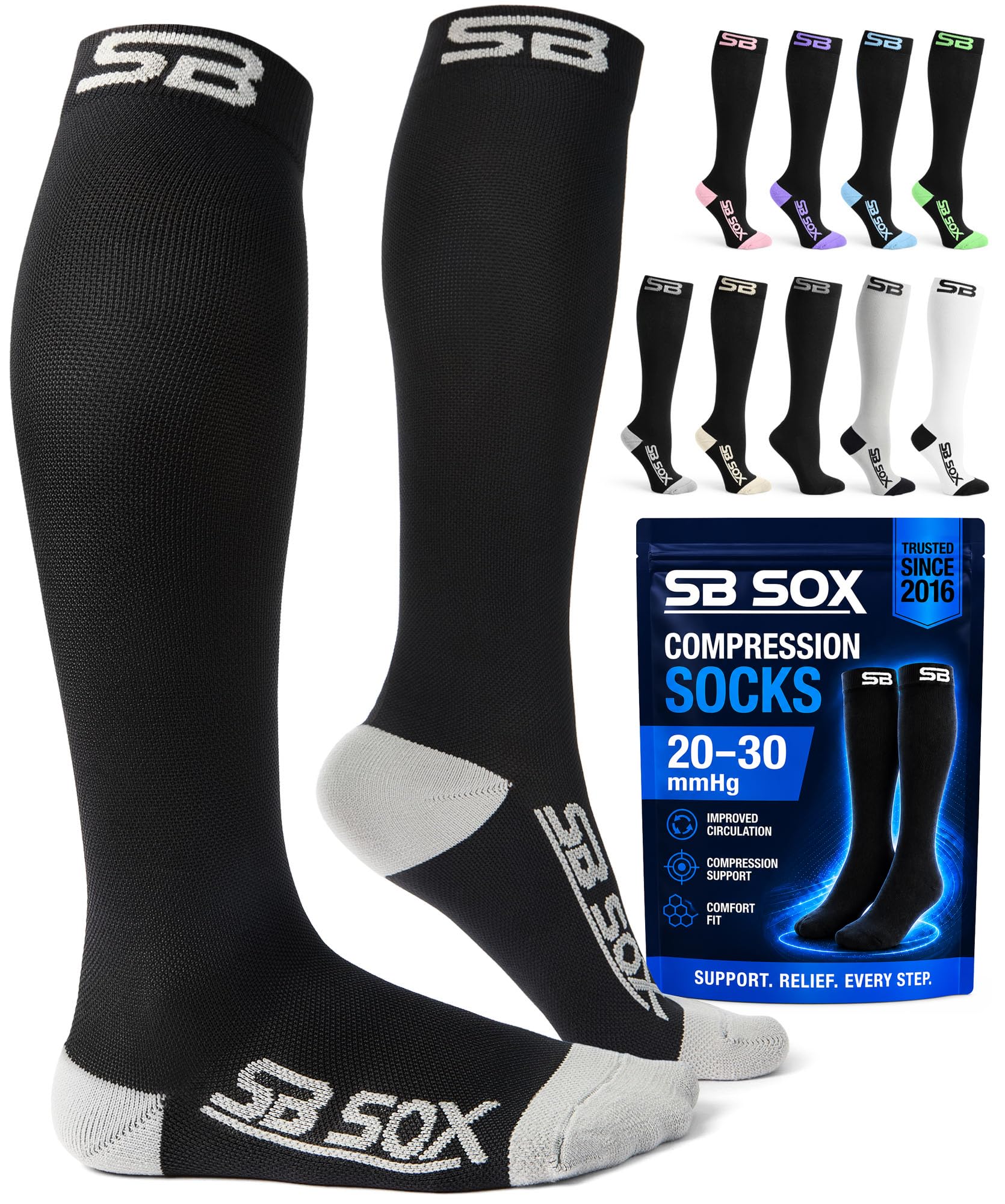
Five calf sizes up to 24 inches, the widest ladder on this list.
Most brands give you a small, medium, and large and hope for the best. SB SOX runs a proper calf-circumference chart — small at 11–14 inches, up through XX-large at 20–24 inches, each with a matching shoe-size range. If your calf has never fit a one-size sock, this is where you start. The knit is 80% nylon and 20% spandex, which is what gives it the grip to stay up without a fight.
Buyers come to it for circulation and swelling relief, and the reinforced, cushioned heel and toe keep it comfortable through a full shift. Repeat buyers coming back for a second pair is the pattern here, which tells you more than any single write-up. Getting them on draws a split — some find it manageable, others find the firm spandex a workout. That is the nature of a sock built to hold its pressure.
Set against the McNick three-pack, this is a single pair with a genuinely better chance of fitting a wide calf. If sizing has been your problem all along, that matters more than any other spec on this page.
The fit advantage
- Calf sizing from 11–14 inches up to 20–24 inches
- 80% nylon, 20% spandex holds its grip through a long day
- Cushioned, reinforced heel and toe for all-day comfort
- Repeat buyers come back for another pair
The trade-off to expect
- Firm spandex makes the pull-on a real effort for some
- You must check both calf and shoe size before ordering
Made for: wide calves, pregnancy, flying, and long shifts where a standard one-size sock has failed you before.
Look past it if: you want a sock that slips on in seconds — this knit holds on purpose.
7. Momcozy Compression Socks for Women, 20-30 mmHg

Built for the swollen-ankle weeks, with a wide-calf lean and a women’s cut.
Momcozy shapes this pair for women and leans toward a wider calf, which is the right call for pregnancy swelling. The 20-30 mmHg graduated squeeze is the core of the design, and reviewers single out its help with pregnancy-related foot and ankle swelling. Comfort and leg support come up alongside the compression itself, which is the pairing you want in a sock you will wear for hours.
The one recurring note is length — some find them too short for a proper knee-high fit on a longer leg. If you are tall or want the compression to run high up the calf, check the length before you commit. For a wide calf and a shorter leg, the fit tends to work the way it should.
Compared to the SB SOX chart-based sizing, this is a simpler women’s fit without the five-step calf ladder. Pick it when you want a pair shaped for pregnancy rather than a unisex sock adapted to it.
The takeaway: a women’s-specific sock that targets pregnancy swelling and wider calves, with length as the one spec to verify first.
Right for you if: you are pregnant, have a wider calf, and want compression built with that shape in mind.
Check the length if: you are tall or want a high knee-high — some find the rise short.
8. VIM & VIGR 20-30 mmHg Cotton Compression Socks

Cotton, not slick synthetic — the pair that stays up without sliding by lunchtime.
Most compression socks are synthetic, and synthetics are exactly what slide down your leg by early afternoon. This one is 48% cotton, 42% nylon, 10% spandex, knit on a 200-needle multi-dimensional weave that keeps the compression firm while staying soft and breathable. It is also latex-free, which matters if you have a sensitivity to it. Cotton is the differentiator — it grips and breathes in a way the nylon-heavy socks on this list do not.
Compression and quality are what buyers praise most, and the look draws notice too — these are the kind of sock you would not hide under a long trouser. Reviewers repeatedly describe their legs feeling energised through the day. QoL on fit is mixed, though: this is a graded sizing run with a Wide Calf option, and getting the right one is on you to check.
The honest trade is at the top end — this is the priciest pair here, and value draws mixed feelings because of it. The cotton is a real upgrade in feel, but you pay for it, and the wash routine needs a little more care than a pure synthetic.
Why the cotton wins: a 200-needle weave holds a firm hold and still feels soft — that combination is rare at this pressure level.
Where it asks more: the highest tier on this page, with mixed feelings on value for the price and a fit you must size deliberately.
Pick it up if: synthetic socks slide down on you and you want a cotton blend that stays put and looks sharp.
Think again if: you want the simplest sizing — this one needs a deliberate pick from the chart.
9. JOBST Relief 20-30 mmHg Compression Stockings

Open-toe, smooth-knit knee-highs for anyone who wears compression every single day.
The open toe is the point of this pair — you can see your toes, check the fit, and wear them without a closed pocket pressing on the front of the foot. The graduated 20-30 mmHg profile runs the full knee-high length, and the knit is smooth textured rather than thick and chunky. JOBST builds a range of these in multiple colours and both beige and black, so you have options beyond the usual white medical look.
Buyers praise the knit quality and the swelling relief, and the smooth texture gets its own mentions. The fit is the honest caveat: some wearers say these run true to size and fit well, while others report bunching around the ankle and knee, or that they come up too small. Bunching is a sizing issue more than anything else — a pair that is even slightly off will gather instead of lying flat.
Compared to the Truform closed-toe pair, the open toe here is the deciding factor. Same pressure class, different daily-use experience.
The practical case: a daily-wear knee-high with an open toe and a smooth knit, best when you want to inspect fit and avoid a closed toe box.
Suits you if: you wear compression daily and want an open toe plus a smooth knit that stays out of the way.
Hold off if: you cannot measure your leg first — bunching at the ankle is a sizing mismatch, not a defect.
Know the Specs
What mmHg means in practice
mmHg stands for millimeters of mercury, a unit of pressure. In a 20-30 mmHg sock, the ankle gets the tightest squeeze and the calf gets the loosest — that downward fade is what graduated compression is. If the pressure does not fade, you are just wearing a tight tube.
Why calf circumference beats shoe size
Shoe size tells you about foot length. It says nothing about the width of your calf, and calf width is what determines whether the sock stays up or rolls down. A sock sized only on shoe size will fit some people well and leave others tugging all day.
Fabric blends and how they behave
High-spandex blends grip and hold their shape. Cotton blends breathe and feel softer. Nylon-dominant knits dry fast and stay affordable. A 48% cotton / 42% nylon / 10% spandex mix behaves very differently from an 80% nylon / 20% spandex one, and both are valid depending on how you wear them.
Open toe versus closed toe
An open toe lets you see your toes and check circulation while wearing the sock. A closed toe feels more like a normal sock but presses on the front of the foot. If you wear compression daily, the open option is often the more practical choice.
Common Questions
What does 20-30 mmHg actually mean for my legs?
How do I measure my calf for compression socks?
Are 20-30 mmHg socks hard to put on?
Can I wear 20-30 mmHg compression socks on a plane?
How long do compression socks last?
Should I choose open toe or closed toe compression socks?
What is the difference between Class I and Class II compression?
How often should I replace compression socks?
Can I sleep in 20-30 mmHg compression socks?
Do compression socks help with wide calves?
The Bottom Line
For most people, the winner is the McNick & Company Men’s Copper Compression Socks — a 21-inch knee-high, three pairs to rotate, and a knit that holds its shape wash after wash. If a wide calf is the thing that has stopped you before, the SB SOX sizing ladder is the one to reach for. And if you want the smooth, open-toe daily-wear experience, the JOBST Relief is the one to check first.
How we choose
We do not accept paid placement. Every pick is matched to a real buyer and a real use-case; we do not hands-on test units.
Sources
Specifications: manufacturer listings and product documentation. Review insights: verified customer reviews, as of November 2026. Pricing: not shown on this page (it changes often); check the current price via the retailer link.
As an Amazon Associate, Doctor Guide Online earns from qualifying purchases. This does not affect which products we feature.