
Specs are compiled from manufacturer listings and verified buyer reviews and can change over time — please confirm the key details on the product page before buying.
You want your lower back to ease off without pills, and you want to spend a sensible amount doing it. Cheap muscle stimulators all promise the same thing — 24 modes, drug-free relief, a picture of a happy person clutching their shoulder. So the real way to tell them apart is what owners say once the novelty wears off. This guide sorts the affordable ones by how strong the actual zap feels, how long the pads keep their grip, and whether the battery dies mid-session.
This guide is built by comparing the manufacturers’ published specifications and the patterns across verified customer reviews, so you get each pick’s real strengths and trade-offs instead of marketing spin.
Below you’ll find the nine units worth shortlisting, sorted so the strongest all-rounder sits first and the pricier specialist devices follow. The wired picks here use standard 2mm pin connectors, while the wireless pods take their own replaceable pads, so refills stay easy to find long after the box arrives. If you want a device that simply works without a manual, this is the shortlist for an affordable TENS unit.
Top Picks


How To Choose The Best Affordable Tens Unit
A TENS unit sends a mild electrical pulse through sticky pads on your skin to interrupt the pain signal your nerves are sending. That’s the whole trick. Everything else — the mode count, the screen, the carry case — is packaging around that one job. So the smart way to shop is to ignore the mode number on the front of the box and check four things instead.
Channels decide how much you can treat at once
A channel is one pair of pads fed by one set of controls. A dual-channel unit has two, which means you can run pads on your lower back and pads on your shoulder simultaneously, each at its own intensity. Single-channel units treat one area at a time. If your pain moves around — back today, knee tomorrow — dual channel lets you treat both spots at once. One of the picks here goes further with four outputs, which lets you cover four body areas or share a session with someone else.
Intensity range matters more than mode count
Intensity is how strong the pulse feels, and it’s the setting you’ll actually touch most. A unit with 20 levels gives you finer control in the comfortable middle than one with a handful of coarse steps. Modes, by contrast, are just preset pulse patterns — knead, tap, knead-and-tap — and most owners settle into two or three they like. Don’t pay extra for 30 modes if the intensity steps are chunky.
The pads are where your money quietly goes
Electrode pads are consumables, like razor blades. A pad that holds its stick for 45 uses costs you far less over a year than one that gives up after a single session. Check the stated reuse count, check whether the connectors are the standard 2mm pin type so cheap third-party pads will fit, and check whether the unit ships with a spare set. The gel pads on these devices all eventually dry out; the question is how long yours last and how easy replacements are to source.
Battery type changes your routine
A rechargeable lithium battery means a USB cable and a charging habit. A 9V or AAA unit means a drawer of disposable batteries and no waiting. Neither is better — it depends on whether you’d rather charge or stock. What you don’t want is a device that quits halfway through a 30-minute session, so check the stated run time against the session length you actually use.
Side-by-Side Comparison
| Model | Best For | Channels / Outputs | Modes | Power Source | Amazon |
|---|---|---|---|---|---|
| AUVON Dual Channel 24 Modes★ Best Overall | Most people, first unit | Dual channel, 2 wires | 24 | Rechargeable lithium, up to 10 hours | Amazon |
| Belifu Dual Channel 24 ModesLong-Haul Pick | Long-haul daily use | Dual channel (A/B) | 24 | Rechargeable lithium polymer | Amazon |
| Therapist’s Choice OTC StimulatorSimplest Controls | No-menu simplicity | Dual independent channels | Adjustable pulse rate and width | 9V battery | Amazon |
| TENS 7000 Digital | Heavy daily pain coverage | Dual channel, 2 lead wires | Multiple TENS modes | 9V battery | Amazon |
| AUVON Wireless 24 Modes | Cordless, wearable relief | 2 pods, wireless | 24 | 790 mAh charging case, Type-C | Amazon |
| Comfytemp 30 Modes Wireless | Wearing it under clothes | 2 wireless units, remote + on-unit buttons | 30 | Rechargeable lithium ion | Amazon |
| Cureve TENS with EMS | Saved settings, low-light use | 2 customizable programs | TENS, EMS and massage programs | Rechargeable lithium ion | Amazon |
| Beurer EM49 | Program variety and guidance | 2 independently adjustable channels, 4 pads | 15 TENS + 35 EMS programs | 3 AAA batteries | Amazon |
Detailed Reviews
1. AUVON Dual Channel TENS Unit 24 Modes Muscle Stimulator
Two independent channels and a battery that genuinely lasts, for the price of a takeaway.
Start with the number that decides most purchases: 12 electrode pads in the box. That’s the most generous pad count on this list, and it matters because the pads are the part that wears out while the unit itself keeps going. Each pad is rated for roughly 45 uses before the gel gives up, so a 12-pad set spreads your replacement cost much further out than a four-pad starter kit.
Two areas at once is what wins people over. Both channels — the two separate pairs of pads — run their own mode and intensity, so you can set channel A to a gentle pulse on a stiff shoulder while channel B runs stronger on your lower back. You get 24 preset modes and 20 intensity levels, plus a session timer you can set as long as 90 minutes. The rechargeable lithium battery is rated for up to 10 hours of continuous use, so most people will forget where they put the USB cable.
The honest catch is durability, and it’s the one mixed note in an otherwise glowing picture. The pads use an American-made adhesive gel built for easy clean-up and reuse, but gel pads of any brand eventually stop gripping, especially if you store them somewhere warm or press them on over lotion. Keep the backing film and reseal them in the pouch between sessions and you’ll get far closer to that 45-use figure. Owners are vocal about the power and the results; this is a device people keep in a drawer and reach for daily.
What earns it the top slot
- Two channels run separate modes and intensities at the same time
- 12 pads included — the biggest starter pack here
- Up to 10 hours per charge from the built-in lithium battery
- Standard 2mm pin connectors make third-party pads easy to source
- Pocket-sized enough to live in a work bag
Where you’ll need to be careful
- The gel pads stop sticking over time, as on every device here
- An 8.47-ounce body is fine on a desk but noticeable in a slim pocket
- You’ll need to remember to charge it before a long session
Reach for this if: you want one unit that covers two sore spots at once and never needs a drawer of spare batteries.
Look elsewhere if: you’d rather not think about charging, or you need four areas treated in one sitting — the four-output AUVON further down does that.
2. Belifu Dual Channel TENS EMS Unit 24 Modes
A pocket-sized workhorse with the strongest owner track record on this entire list.
Carrying it around is where the weight question gets real: this unit weighs 9.88 ounces, while the Therapist’s Choice model below comes in at 3.53 ounces. That’s a big difference in the hand — but the Belifu is still small enough to sit in a bag, and the extra weight is the price of a rechargeable lithium polymer battery instead of a disposable 9V cell. Whether that trade matters depends on how often you’re carrying it versus leaving it on a bedside table.
The spec sheet reads like a competent mid-range machine: 24 preset modes, 20 intensity levels, and dual A/B channels that each take their own intensity setting. The battery indicator tells you when to plug in rather than leaving you stranded mid-session, and it charges from a wall charger, power bank or laptop USB port. You get 10 pads rated for up to 50 uses apiece, plus a dust-proof drawstring bag with reusable fastening cable ties to keep the lead wires from knotting.
Raw output keeps this unit in so many homes, and it’s why it has built up one of the largest owner bases in this guide. The honest trade is adhesion. Some pads grip for weeks and some give out quickly, and the difference usually depends on skin prep: wipe the area dry, skip lotion, and press the pad down firmly for a few seconds. Get that right and this is one of the cheapest ways to own a genuinely capable dual-channel device.
Why owners keep buying it
- 24 modes, 20 intensity levels, and 10 pads rated to 50 uses each
- Battery level indicator warns you before a session dies
- Fastening cable ties and a drawstring bag keep the wires tidy
- Charges from any USB port, so no battery drawer
The trade-offs to weigh
- At 9.88 ounces it’s noticeably heavier in the hand than the slimline 9V units
- Pad grip is inconsistent between sets — prep the skin properly
Best buy for daily use: you want a rechargeable dual-channel unit with a big pad bundle and tidy storage, and you don’t mind a little heft.
Slimmer alternative: if portability is everything, the 3.53-ounce Therapist’s Choice below is the one to weigh up.
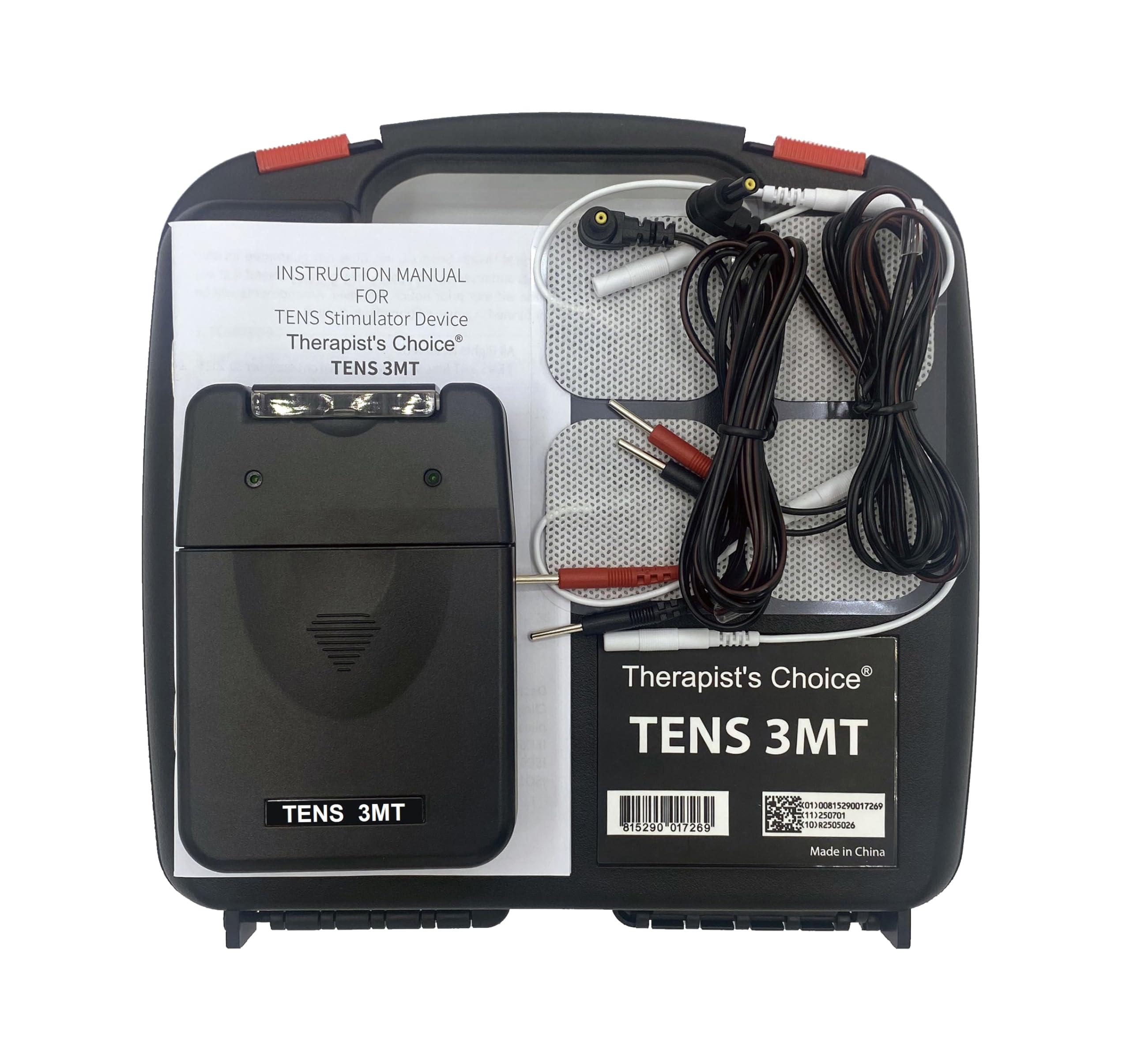
3. Therapist’s Choice TENS Unit
Dial-style controls for anyone who has no patience for menus and mode numbers.
No screen to scroll, no mode list to learn. This unit works like an analog radio: you turn up the intensity, you adjust the pulse rate, you adjust the pulse width, and you’re done. The controls are precise rather than primitive, but there’s nothing to memorise. For anyone who has watched a parent give up on a device because it had nineteen buttons, three dials are the whole appeal.
Physically it’s the lightest thing here by a wide margin. At 3.53 ounces versus the 9.88-ounce Belifu reviewed above, it’s the kind of difference you feel when you clip it to a belt and forget it’s there. The package measures 7.4 x 7.4 x 2.24 inches, which is largely the hard carrying case, since the unit itself is compact. Inside the box you get the dual-channel stimulator, lead wires, starter self-adhesive electrodes, a 9V battery, a belt clip, the case, and an instruction booklet.
Running on a 9V battery is the whole point of the design: no charging cable, no waiting, no lithium cell to age out. The flip side is a disposable battery habit and no low-battery warning, so keep a spare in the case. Both channels adjust independently, and the whole thing uses industry-standard electrodes, lead wires and batteries, so replacements are easy to pick up anywhere. Owners tend to find the output strong; if you’re new to TENS, start low and work up.
Where it shines: a belt clip, a hard case and a 9V battery add up to a device that lives in a bag and comes out ready, with zero charging routine.
What to expect: analog controls give you fewer named modes than the 24-mode units here, so you dial in the sensation yourself rather than picking a preset.
Buy this one if: simplicity and portability beat program variety, or you’re setting up a device for someone who wants knobs, not menus.
Pass if: you want a rechargeable unit and a long list of preset programs — the Belifu or the AUVON dual channel covers that better.
4. TENS 7000 Digital TENS Unit with Accessories

The clinic-cabinet workhorse physical therapists have handed out for years, reliability complaints included.
This is the most familiar face in the category, and the reason is simple: it does the job with enough power for people who’ve been putting up with pain for a long time. The digital controls cover multiple TENS therapy modes, and the package is complete on arrival — the unit, two lead wires, a four-pack of reusable premium electrode pads, a 9V battery, a manual and a hard carrying case. Nothing extra to buy before your first session.
The honest side of its reputation is reliability. Alongside the praise for power and results sits a recurring thread about units that stop working or won’t power on, and about batteries that drain faster than expected. That’s a real risk to weigh, and it’s why some buyers keep a spare unit or lean on the return window. It also sits at 13.7 ounces, the heaviest device here, so it’s a bedside-table companion rather than a pocket one.
What keeps people loyal is how hard it hits. The output is strong enough that many long-term users never push past the lower intensity settings, and the 9V battery means no charging cable to remember. It’s a straightforward, well-known machine with a large following and a small but real failure rate — roughly what you’d expect from a device this widely used.
What it gets right
- Everything needed to start is in the box, including the 9V battery and hard case
- Strong output that suits long-standing, stubborn pain
- Runs on a standard 9V cell, so no charging downtime
What to factor in
- At 13.7 ounces it’s the heaviest unit in this guide
- A recurring reliability thread means you should test it thoroughly early on
- Battery drain is inconsistent between units
Suits stubborn, long-running pain: if you need serious output and a no-fuss 9V setup, this has the pedigree.
Consider the Belifu instead if: you want a rechargeable unit with the same dual-channel layout and a lighter carry.
5. AUVON Wireless 24 Modes TENS Unit Muscle Stimulator
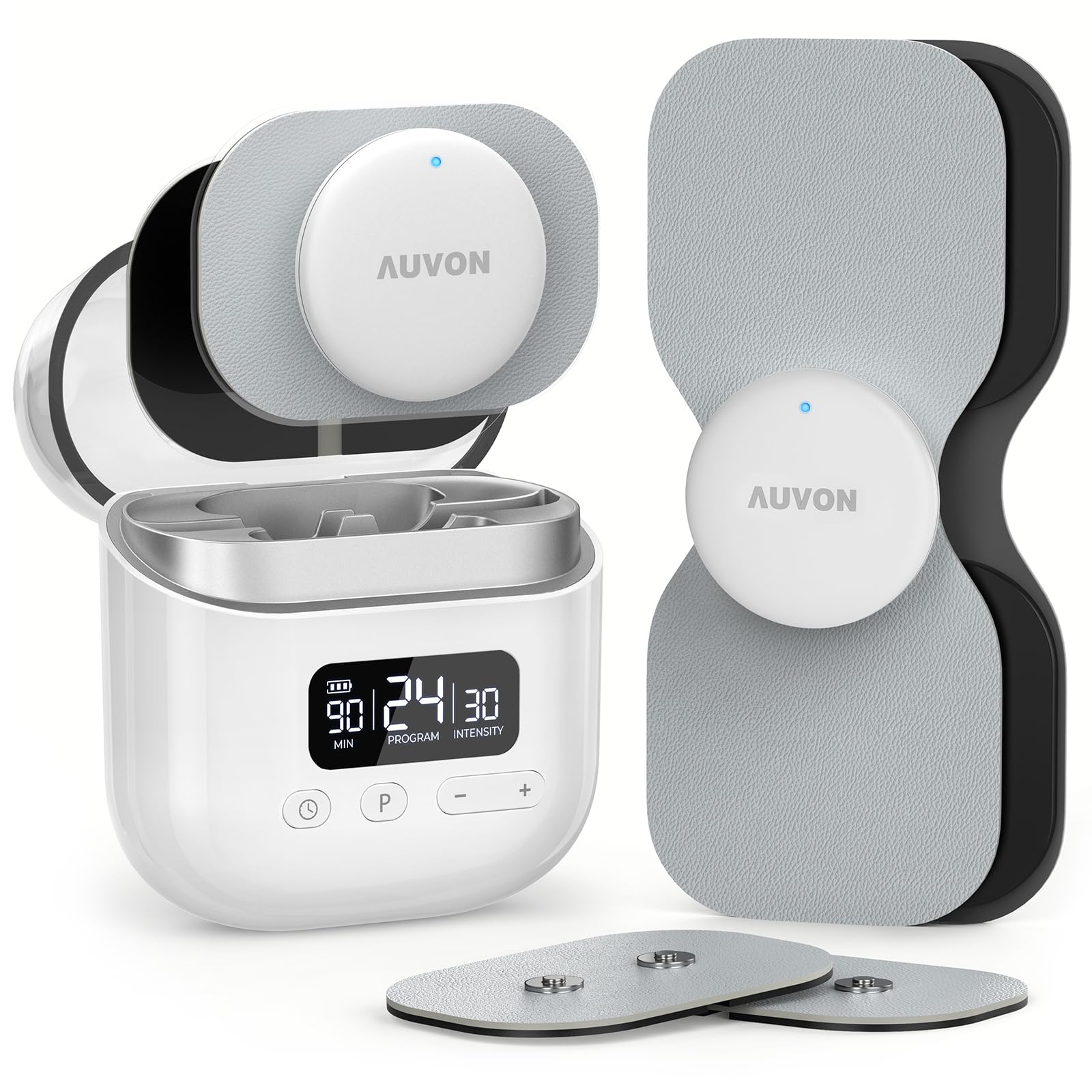
Two pods that stick where you put them, with no lead wires to snag on a chair arm.
The wires are the first thing to go. Instead of a controller tethered to pads, you get two self-contained pods that snap onto the electrode pads and communicate with a charging case. That means you can treat your back and then walk to the kitchen without unclipping anything. If you’ve ever caught a lead wire on a door handle mid-session, you’ll understand why owners like the pod design.
The numbers are strong: 24 modes across TENS, EMS and massage, plus 30 adjustable intensity levels for fine control. The charging case holds a 790 mAh battery rated at up to 40 hours on a full charge — enough for one pod to run 40 hours or two pods to run 20. Each pod runs up to 8 hours individually, and a 10-minute top-up in the case gives you an hour of therapy. Sessions set from 10 to 90 minutes, with a 30-minute default, and charging happens over Type-C.
Pads come in two shapes: two large panels measuring 2.2″ x 5.1″ for shoulders and back, and four smaller 2.4″ x 1.7″ pads for ankles and waists. The PU surface and gel are rated for up to 45 uses. The sticking point — literally — is that some pads hold firm and others loosen quickly, so treat the backings kindly. The maker also flags clearly that TENS isn’t suitable for people with pacemakers, pregnant women, or those with epilepsy.
The freedom argument: no lead wires means you can move, cook, or walk the dog with therapy running, and the case doubles as the charger so nothing gets lost.
The honest caveat: pods are small, so losing one is easier than losing a wired controller — keep them in the case when they’re not on your skin.
Made for movers: you want relief while you’re up and about, not strapped to a chair by a cable.
Skip the upgrade if: you treat one spot on the sofa and don’t mind a wire — a wired dual-channel unit costs less and covers the same job.
6. Comfytemp 30 Modes Wireless TENS Unit
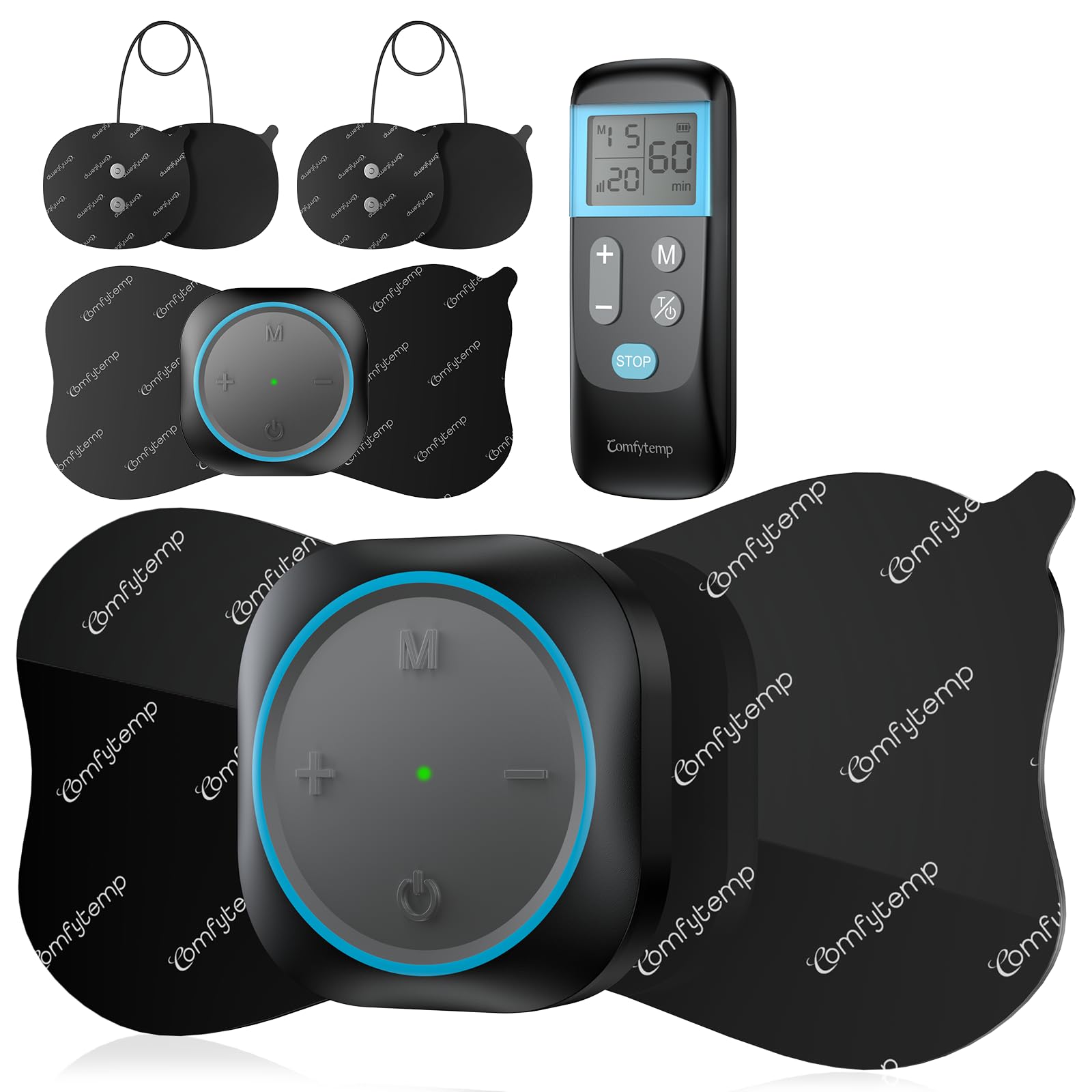
Thirty modes, two ways to control them, and a body-hugging shape that hides under a shirt.
Finding a pulse pattern that suits your ache is the point of the highest mode count in this guide — 30 modes paired with 20 intensity levels, split between TENS and muscle stimulation. That’s more presets than most people will ever cycle through, but it means the odds of finding one that fits your particular ache are high. Dual wireless units let you treat two areas at once, or hand one to a family member.
The control design is the thoughtful part. You get a remote for when you’re lying on the sofa and want to change settings without reaching, and physical buttons on each pod for when you’ve left the remote in another room. Both routes do the same job. The dual units are built to sit discreetly under clothing, which makes this the closest thing here to a device you can wear through a workday rather than switch on for twenty minutes and take off.
Pads come in two shapes: two butterfly pads at 5.2 x 2.4 inches for backs and shoulders, and two line pads at 3.5 x 2.8 inches for arms and legs. They’re rated for 60+ reuse cycles, and when grip fades you can rinse them, scrape off the surface residue, air-dry, and the adhesion comes back. A portable carrying case keeps everything organised. The recurring wobble is stickiness — some pads hold well, some don’t — so follow the rinse-and-dry routine rather than replacing them early.
Two control paths, one device: the remote plus on-pod buttons means you’re never stuck if one goes missing or out of reach.
Pads that can be revived: the stated 60+ cycle rating plus the rinse-and-air-dry trick makes this one of the longer-lasting pad setups here.
Ideal for all-day wear: you want relief during commutes and desk hours, with the option to hide the pods under clothes.
Worth weighing against the AUVON wireless: both are cordless, but this one adds 6 extra modes and a remote in exchange for a shorter pod run time.
7. Cureve TENS Unit Muscle Stimulator with EMS

Built with two safeguards most rivals skip, and a screen you can read in the dark.
The feature worth paying attention to here is the pad attachment sensor. It blocks all output until both pads are sitting firmly on your skin, which takes away the unpleasant jolt that comes from a pad peeling loose mid-session. The second safeguard is an intensity lock, so a bumped button can’t suddenly jump the current while you’re wearing it. If you’ve ever been startled by a stray zap from a lifting pad, those two safeguards are the reason to pick it.
The unit combines three jobs: TENS for pain, EMS for muscle recovery and strengthening, and massage programs for general tension. Two customizable programs let you — or your physical therapist or chiropractor — set exactly what works and lock it in. The large backlit screen shows mode, intensity and time in large text, readable in a dark room or without reading glasses, and it always remembers your last settings so you’re running again the moment you switch it on. It’s rechargeable, lightweight, and small enough to travel, and it’s covered by a two-year warranty.
The electrode gel is manufactured in the USA, with the aim of stronger stick, more uses per pad and comfortable daily wear on sensitive skin. With a pad sensor and an intensity lock, it’s the most safety-thoughtful unit here for anyone nervous about electricity on their body. What it doesn’t offer is the huge preset menu of the 30-mode units — its strength is in the setup and the safeguards, not mode variety.
For the cautious first-timer: you want safeguards that stop a mis-set intensity or a lifted pad from ruining the experience, plus a screen you can read at night.
Only if you need the safeguards: if you’re experienced and just want maximum modes, cheaper units elsewhere in this list give you more presets.
8. Beurer EM49 Digital TENS & EMS Device
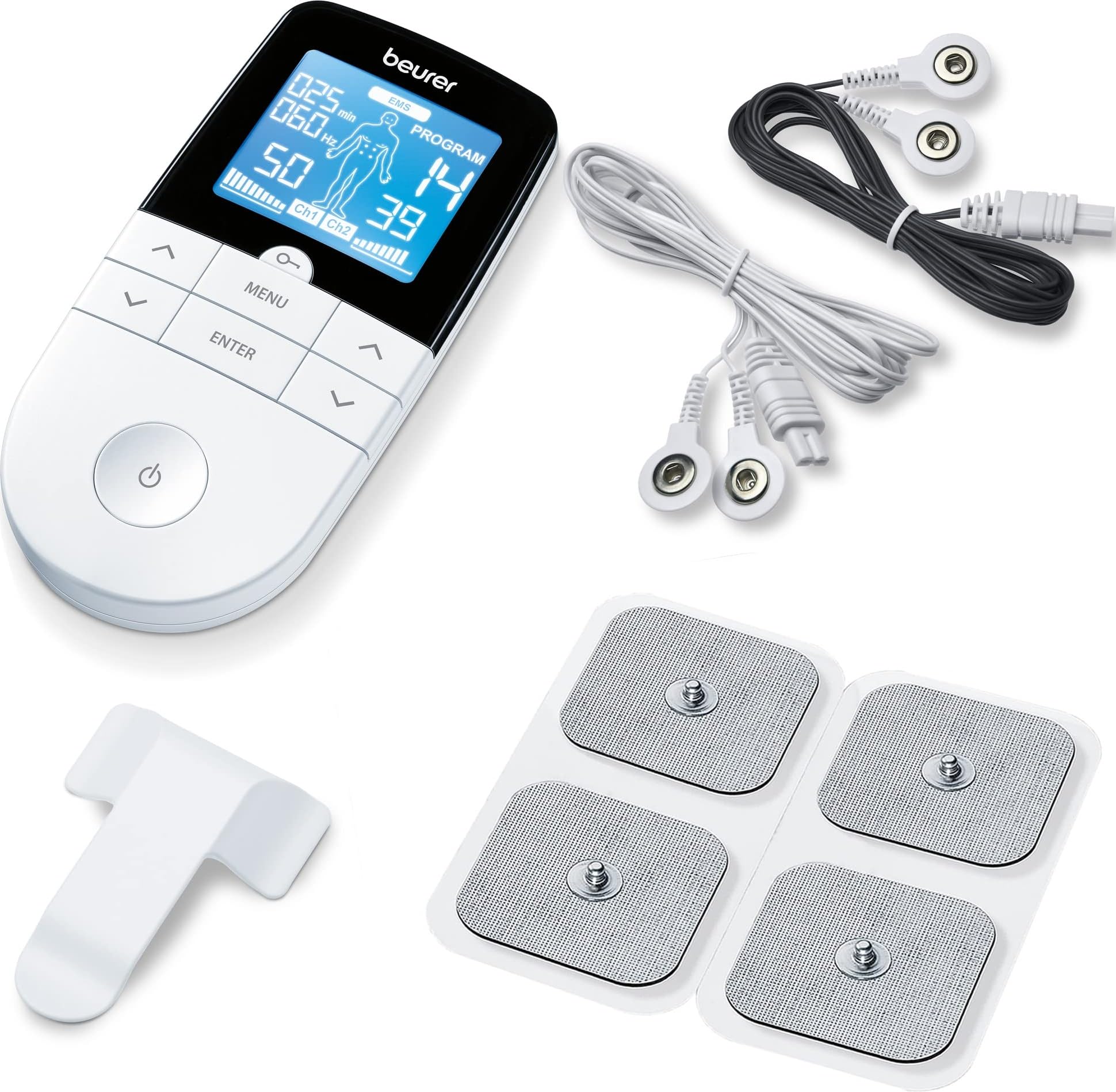
Fifty separate programs and an on-screen guide that shows you where to place the pads.
The program count is the headline: 15 preset TENS programs for pain, 35 EMS programs for muscle work, and 6 customizable settings on top. That’s a wider menu than anything else on this list, and it’s paired with two independently adjustable channels and four self-adhesive electrodes so you can treat your back at one intensity and your knee at another.
The on-screen electrode placement guide is the quietly clever bit. It shows where to put the pads for back, neck, knee and sciatica support, which removes the guesswork that catches most newcomers. The Doctor’s Function then lets you save your preferred setup so every future session is one button away. Battery life comes from 3 AAA batteries, and the unit is light enough at 3.9 ounces to travel in a bag.
The honest side is reliability. A recurring thread of reviews reports units that stop working, and pad adhesion also draws some criticism — neither is universal, but both are worth knowing before you commit. On ease of use the device is well liked, with a clear layout and straightforward navigation. If you want program variety and guidance, it delivers; if you want the simplest, most durable-feeling machine, a wired dual-channel unit will suit you better.
A guided program library: the electrode placement guide plus Doctor’s Function turns a 50-program device into a one-button routine once you’ve found your settings.
The reliability question: some units fail and some pads lose grip, so buy somewhere you can return easily and test thoroughly in the first weeks.
Best if you want a program for everything: a huge library plus on-screen placement guidance and saved settings.
Second-guess it if: long-term reliability is your top priority — the wired dual-channel options in this guide carry a steadier record.
Know the Specs
Channels and outputs explained
A channel is one pair of electrode pads on a separate control circuit. Dual channel means you can treat two areas at once with different intensities — useful when one spot needs a gentle pulse and another needs more. Outputs take that further: a four-output unit feeds four separate pad pairs, up to eight pads, so you can cover more body areas or split a session between two people. If your pain moves around, more channels give you flexibility. If you treat one spot, a single-channel unit is enough.
Intensity levels and modes
Intensity is the strength of the pulse; modes are the patterns it runs in (knead, tap, and similar). Intensity is the setting you’ll touch most, so a wide range of levels gives you finer control in the comfortable middle. More modes just means more preset patterns — most people settle on two or three. Don’t pay extra for a huge mode count if the intensity range is coarse; you’ll feel the difference in comfort long before you notice the extra presets.
Pads and running costs
Electrode pads are the consumable part, not the unit. A pad rated for 45 uses is a far better deal than one that gives up after a handful of sessions, so the reuse count is a real cost line. Standard 2mm pin connectors let you buy third-party pads cheaply. Gel pads dry out over time — store them on their backing film in a sealed bag, skip lotion before applying, and press firmly for a few seconds to get the full life out of them.
Battery type and run time
Rechargeable lithium batteries mean a USB cable and a charging habit; 9V or AAA batteries mean a drawer of disposables and no waiting. Lithium units often quote long run times — up to 10 hours on some here — while a 9V cell is a known quantity you can swap in seconds. The practical question is whether a session will ever die mid-way. Check the stated run time against your typical session length and keep a spare battery or a charged cable within reach either way.
Common Questions
Can I use an affordable TENS unit for back pain every day?
What is the difference between TENS and EMS on these devices?
How long do the electrode pads last before I need new ones?
Do cheap TENS pads from other brands fit these units?
Is a wireless TENS unit as strong as a wired one?
Will a TENS unit interfere with a pacemaker or other implants?
How long does a 9V battery last in a TENS unit compared with a rechargeable one?
Can more than one person use the same TENS unit?
What does pulse rate and pulse width actually change?
Is a four-output TENS unit worth choosing over a dual-channel?
The Bottom Line
Daily use without a charging scramble is why the affordable tens unit that makes the most sense for most buyers is the AUVON Dual Channel 24 Modes — it pairs two independent channels with 12 included pads and a battery rated for up to 10 hours. If your pain moves around or you want to share a session, the AUVON 4-Output model gives you four outputs and 8 pads for the same price band. And if you want the safety features that stop a stray zap, the Cureve TENS with EMS is the pick to reach for.
The Belifu remains the value champion for anyone who wants a rechargeable dual-channel workhorse with 10 pads and a long-standing following, while the Therapist’s Choice at 3.53 ounces is the answer for anyone who wants to clip a device to a belt and forget it. The one honest nudge: these units are inexpensive enough that the right move is to buy the one whose channel count and power source match your routine, rather than paying more for a mode count you’ll never cycle through.
How we choose
We do not accept paid placement. Every pick is matched to a real buyer and a real use-case; we do not hands-on test units.
Sources
Specifications: manufacturer listings and product documentation. Review insights: verified customer reviews, as of November 2026. Pricing: not shown on this page (it changes often); check the current price via the retailer link.
As an Amazon Associate, Doctor Guide Online earns from qualifying purchases. This does not affect which products we feature.