
Specs are compiled from manufacturer listings and verified buyer reviews and can change over time — please confirm the key details on the product page before buying.
If you are shopping for someone who cannot shift their own weight in bed, the thing that matters most is whether the mattress actually moves pressure around — not how thick the box is. An alternating pressure mattress does that job with air cells that inflate and deflate in cycles, and every pick below pairs those cells with an electric pump. The MedVance Alternating Pressure Mattress takes the top spot because it combines a sub-20 dB pump with a hospital-grade nylon cover and a one-pull CPR deflate tag, at 4.0+ stars from a large body of buyers.
This guide is built by comparing the manufacturers’ published specifications and the patterns across verified customer reviews, so you get each pick’s real strengths and trade-offs instead of marketing spin.
You will see cell counts, weight limits, pump noise figures and cover materials side by side, so the choice becomes about fit rather than guesswork. Here is how to read an air mattress for pressure sores listing without getting buried in the spec sheet.
Top Picks

How To Choose The Best Air Mattress For Pressure Sores
An alternating pressure pad is a topper or replacement mattress built from rows of air cells. A pump cycles air between two sets of cells, so the spots taking your loved one’s body weight keep changing. That motion is the whole point, and it is the first thing to check on any listing.
Alternating cells versus one static cushion
A static air pad holds one pressure profile all night. An alternating pad shifts the high-pressure points on a cycle, which is why these are sold as bedsore prevention and management gear rather than plain comfort toppers. If the listing does not name alternating pressure or low air loss, it is not doing this job.
Static mode is a caregiver feature, not a gimmick
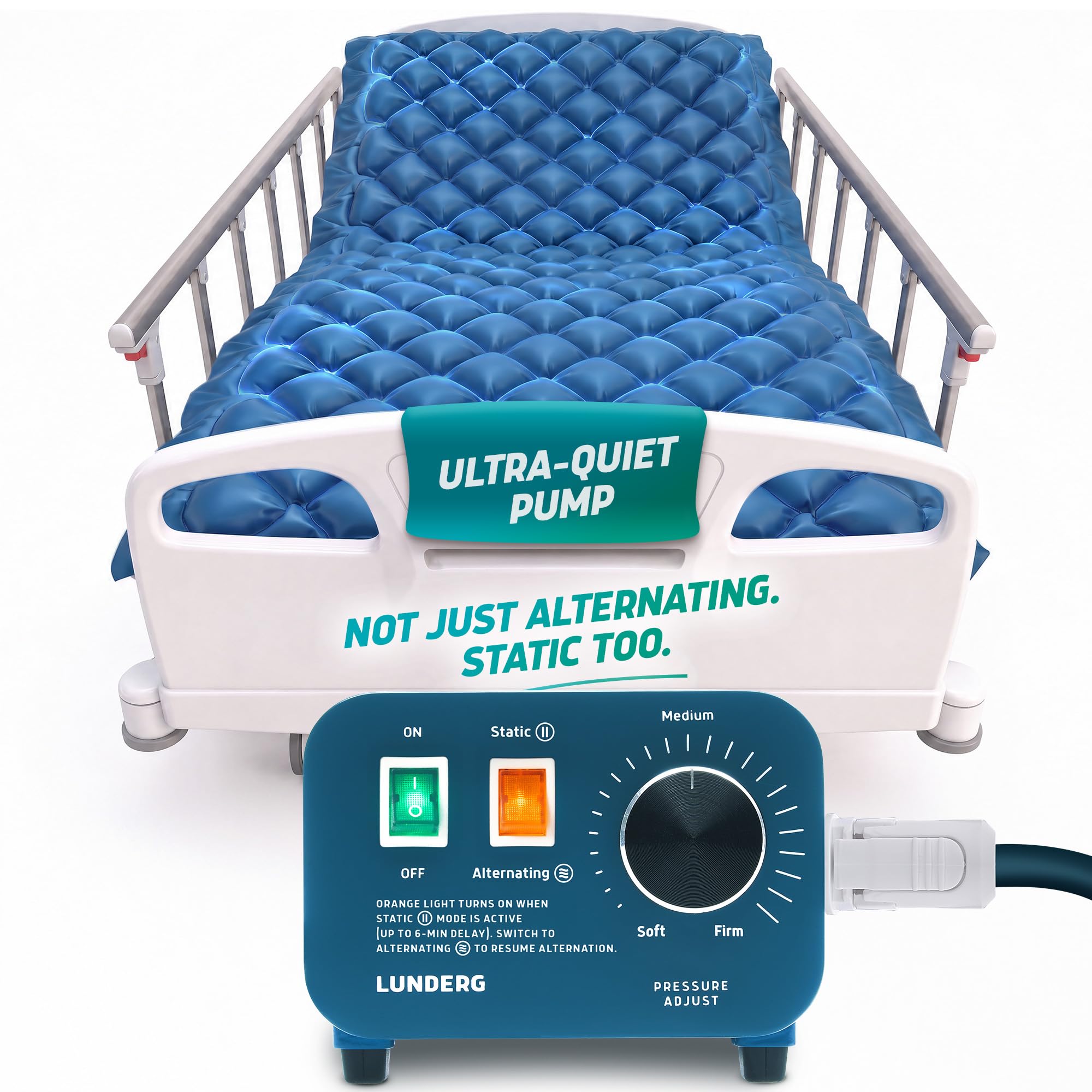
Some pumps let you freeze every cell fully inflated. That gives a firm, stable surface for transfers, repositioning, or a nap where movement is uncomfortable. Lunderg, Alcedo, VOCIC, and the Vive 8-inch all offer this, and it is worth having.
Pump noise in decibels
The pump runs all night in the same room as the person sleeping. A decibel (dB) is a unit of sound loudness — a quiet library sits somewhere in the 30s. The MedVance pump is rated under 20 dB, while the Lunderg pumps are listed at 23 dBA. The VOCIC ceramic pump is rated at 45 dB, which is a louder bedroom companion.
Weight capacity and how the pad stays put
Capacity is the load the air cells will carry before they bottom out — meaning the body sinks through to the mattress beneath. Capacities here run from 300 lbs up to 440 lbs. End flaps, anti-slip coatings, and adjustable straps decide whether the pad slides when someone is turned.
Side-by-Side Comparison
| Model | Best For | Weight Capacity | Pump Noise | Static Mode | Amazon |
|---|---|---|---|---|---|
| MedVance Alternating Pressure Mattress★ Best Overall | Best Overall | — | Under 20 dB | — | Amazon |
| Lunderg Alternating Air Pressure PadQuietest Full-Feature Pad | Quietest Full-Feature Pad | 300 lbs | 23 dBA | Yes | Amazon |
| Alcedo Alternating Pressure Mattress PadBest Sleep Quality | Best Sleep Quality | 300 lbs | — | Yes | Amazon |
| Lunderg Queen Flocking Pad | Larger Beds | 320 lbs | 23 dBA | Yes | Amazon |
| VOCIC Alternating Air Pressure Pad | Heaviest User Support | 440 lbs | 45 dB | Yes | Amazon |
| Vive 5″ Alternating Pressure Mattress | Most Air Chambers | 300 lbs | — | — | Amazon |
| Vive 8″ Low Air Loss Mattress | Full Replacement Set | 350 lbs | — | Yes | Amazon |
| Drive Medical Med-Aire System | Replaceable Bladders | — | — | — | Amazon |
| KEUZ Alternating Air Pressure Pad | Budget Champion | 300 lbs | — | — | Amazon |
Detailed Reviews
1. MedVance Alternating Pressure Mattress
Our pick — 4.0+★ from 750+ verified ratings; the strongest balance of quality and price.
The pad that keeps the pump quiet enough to forget, and the cover comfortable enough to stay on.
The pump is the standout here. MedVance rates it at under 20 dB, and a decibel is a measure of how loud a sound is — a whisper sits around that level. Two pump cores feed the cells so output stays strong, and a digital panel with diagnostic alarms lets a caregiver dial the pressure to the person rather than guessing at a knob. If the bedroom is shared, this is the spec that decides whether anyone sleeps.
What keeps the whole thing bearable day to day is the quilted poly PU cover, which is water resistant and wipes down. It carries an anti-slip coating and straps to the bed frame, so the pad does not creep when someone is being turned. The emergency CPR function is the detail that matters in a scare: pull the red tag and the mattress deflates within a second.
Buyers talk most about comfort, then bedsore prevention. The honest catch sits in the air system and the noise — some find the pump whisper-quiet, others call it loud, and a few report the cells not holding air properly. Check the hose connections at setup and keep the pump off soft carpeting. The pure-plush firmness also takes getting used to if you are moving over from a foam topper.
What earns the top slot
- Pump is rated under 20 dB, so it fades into the background at night.
- Quilted water-resistant cover with anti-slip coating and frame straps.
- Red-tag CPR deflate empties the mattress within a second.
- Digital adjustment plus diagnostic alarms for tuning pressure to the person.
What to know before ordering
- Cover is hand wash only, so plan on spot cleaning between washes.
- Air pressure and noise both draw split feedback — seal the hoses firmly.
- Plush firmness is softer than a foam topper, which some users notice.
Suits: households where the pump lives in the sleeping room and quiet is non-negotiable.
Second thought: the cover needs hand washing, so expect spot cleaning to carry the load.
2. Lunderg Alternating Air Pressure Mattress Pad
A 23 dBA pump with a static mode that turns the cycling off when calm matters more than motion.
Functionality carries this pad in the reviews — the cycling does what it is supposed to do, and the setup is quick enough that caregivers are not reading a manual at midnight. The pump is rated whisper-quiet at 23 dBA, and a decibel here is a loudness unit, so that number means a bedroom-level hum rather than a rattle. A knob runs the surface from soft to firm so you can tune it to a lighter or heavier body.
Static mode is the piece that saves a difficult night. Flip it and every cell stays fully inflated for a stable, even surface — useful during transfers or when the alternating motion is irritating. The pad is waterproof PVC, supports up to 300 lbs, and hooks to the pump with a quick connector. Setup runs about 20 minutes across 3 cycles before you settle the pressure at “Firm” and ease it back.
Buyers repeatedly mention less hip and tailbone pressure after a few nights on the PVC surface. The trade-off is airflow and leakage — a slice of buyers find the surface runs warm, and some hit a leak. Spread a sheet over the waterproof top as the maker suggests, since PVC against bare skin traps heat and moisture.
Where it wins: a sub-24 dBA pump paired with a stable static mode, a waterproof PVC cover and 300 lbs of support — the combination caregivers ask for most.
Where to watch: PVC is the noisier, warmer option against the flocked and nylon surfaces on this list, and the waterproof top is best covered with a sheet.
Go for it when: you want a well-mannered pump plus the ability to freeze the surface flat on demand.
Different pick if: night sweats are already a problem — a breathable flocked or nylon top suits better.
3. Alcedo Alternating Pressure Mattress Pad
Built around one goal: an undisturbed night on a surface that quietly does the work.
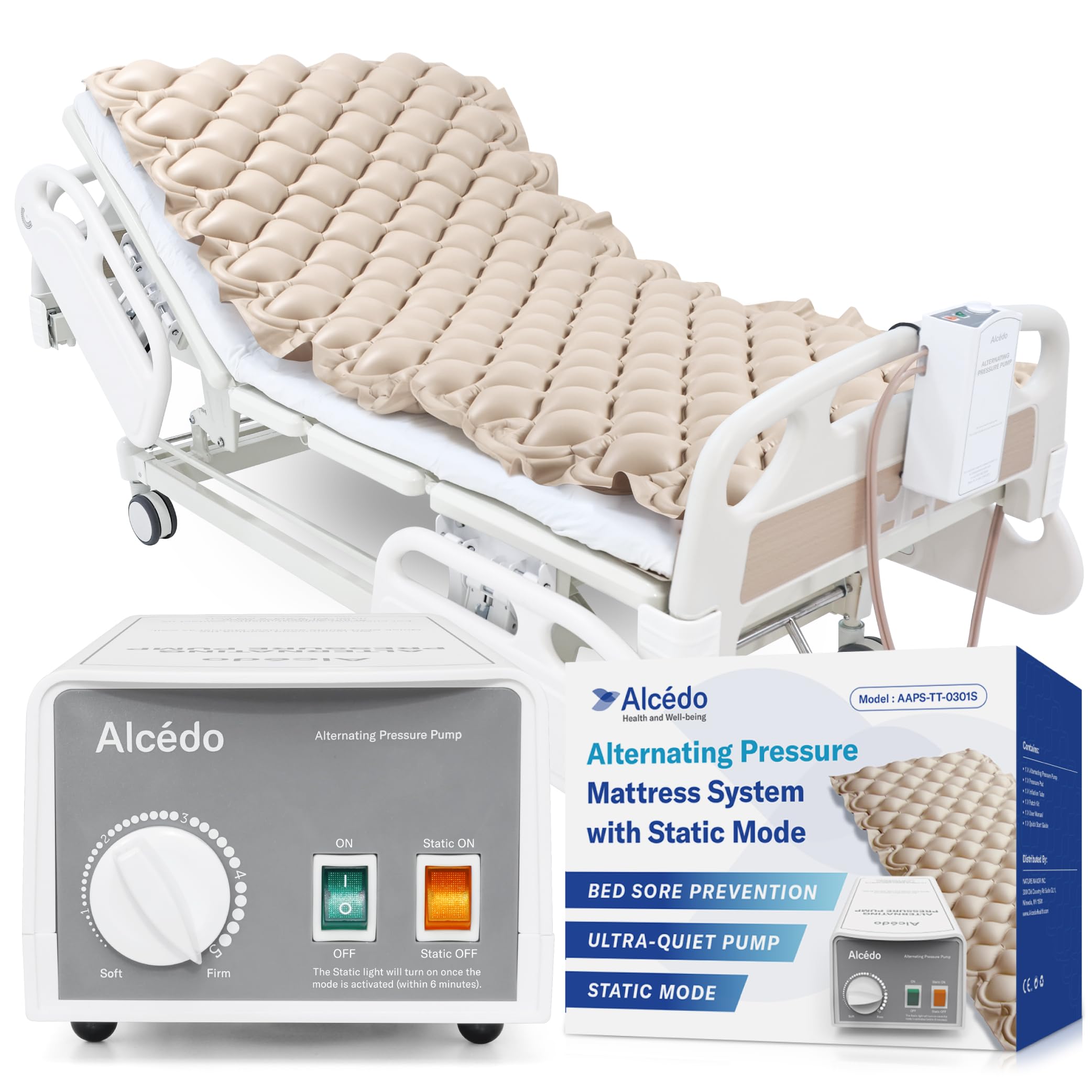
Sleep quality is the reason to pick this one over its neighbors. The pump dials from soft to firm during alternating cycles, and in static mode every air cell stays inflated for an even, stable bed. Set it, walk away, and the cycling carries on — which is the entire point of an alternating topper on a long-term care bed.
The bubble area measures 75″ x 35″, so it lands on a hospital bed, a homecare frame, or a standard bed. High-density material with reinforced seams supports up to 300 lbs and holds its shape. The breathable waterproof surface wipes clean, and the pad is FSA/HSA eligible, so health account funds can cover it.
Reviewers write most about comfort and bedsore prevention, then pain relief and price. Tuck the uninflated excess under the mattress as the maker directs so it does not bunch. One honest note: airflow draws mixed feedback, and a few find the surface warmer than expected — the breathable cover helps, but a cotton sheet over the top does more.
The pull: a soft-to-firm dial, a static mode for stable stretches, reinforced seams across a 75″ x 35″ bubble area, and health-account eligibility.
Fits the caregiver who wants to set the pressure once and let the pad run through the night.
Only hesitation: the cover is hand wash only, and the surface can run warm for some sleepers.
4. Lunderg Queen Size Alternating Air Pressure Mattress Pad

The wide version of the Lunderg formula, with a flocked top that stops the plastic-bag feel.
Most pads here are sized for a standard bed, and this one is the exception. At 53×77 inches it covers a queen or larger bed and supports up to 320 lbs, so a bigger person is not stuck at the edge of an undersized pad. If your loved one sleeps in a full or queen bed at home, that alone narrows the list to this.
The flocking is the other real difference. Vinyl and PVC pads can feel like sleeping on a plastic bag — hot and sticky against bare skin. The flocked surface reads like fabric, which helps a sleeper rest without sweating. The pump runs at 23 dBA, includes a static mode that holds every cell inflated, and connects with a quick connector. Full inflation takes about 20 minutes across 3 cycles.
Buyers mention the 23 dBA pump most, then bedsore relief. Adjustability and inflation draw mixed notes — a few find the firmness dial less precise than they wanted. Set it to “Firm” first, then ease the knob back to comfort. Durability is the other split point, so store the pad flat and away from sharp edges.
Why it earns a slot: a 53×77 inch sleeping surface with a 320 lbs capacity and a flocked top that breathes against skin — the size and material story in one package.
Right choice if your loved one uses a queen or larger bed and wants a surface that does not stick.
The real gap: the pressure knob is coarser than the digital pumps elsewhere, so fine-tuning takes a patient hand.
5. VOCIC Alternating Air Pressure Mattress Pad
A 440 lbs air support system in nylon TPU, with a CPR pull that empties it in seconds.
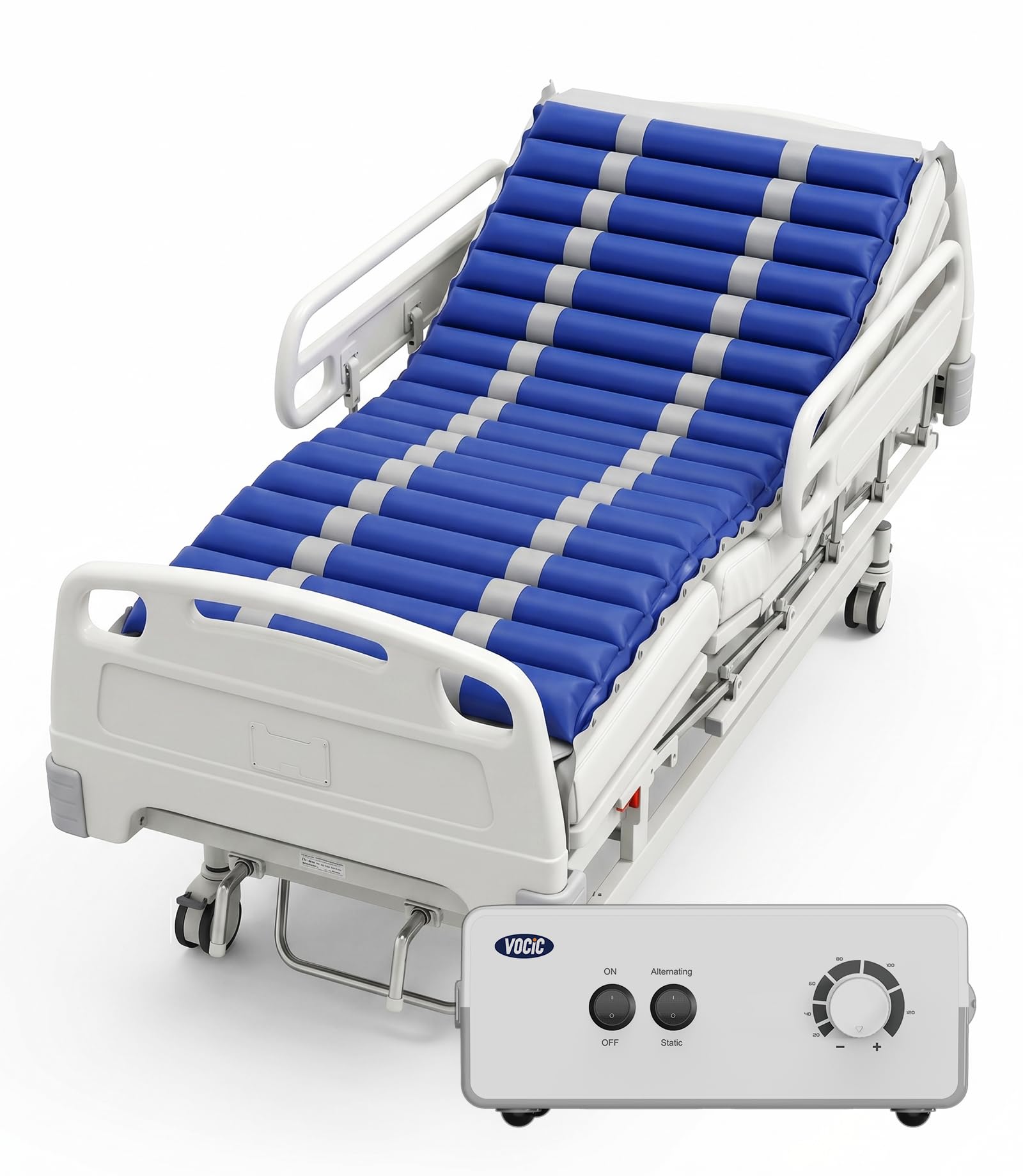
This pad stands apart on weight capacity. Its high-resilience air cells (durable cells that spring back) hold up to 440 lbs (200 kg) without bottoming out (sinking until you feel the base). That is well above the 300 lbs cap most pads in this guide carry. If your loved one’s weight made other pads sink through, this is the one built for it.
The surface is nylon polyether TPU with a supple, breathable hand. It wipes clean because the waterproof face has no dead corners, and minor punctures patch with the included repair solution. A protective cover ships in the box — dustproof, waterproof and breathable — so you are not buying an extra layer on top. Inflated it measures 75″ x 31″ x 4″, giving a generous but not oversized footprint.
Two features sell the safety story. The ceramic pump is rated whisper-quiet at 45 dB with strong air retention, and one-touch static mode firms the whole surface for care and repositioning. The CPR quick-release channel empties the entire mattress in seconds with a single pull. Worth pairing with the pump’s rated noise: 45 dB is louder than the sub-24 dBA pumps elsewhere here, so if the bed sits in a shared room, plan the pump’s placement. VOCIC claims 3+ years of daily use from the TPU, though that is a maker claim, not a warranty.
Build and safety: nylon polyether TPU, a cover included, 440 lbs of support and a CPR quick-release all in one system — with a pump that runs at 45 dB.
Check before you buy: that 45 dB rating is the loudest on this list, so a hallway or a quiet corner for the pump helps.
Best for you if a heavier user has been sinking through other pads and you need the extra air support.
Trade-off to weigh: a 45 dB pump is audible in a bedroom in a way the sub-24 dBA models are not.
6. Vive 5″ Alternating Pressure Mattress
Sixteen sealed cells under a breathable vinyl cover, adjustable from soft to firm at the pump dial.
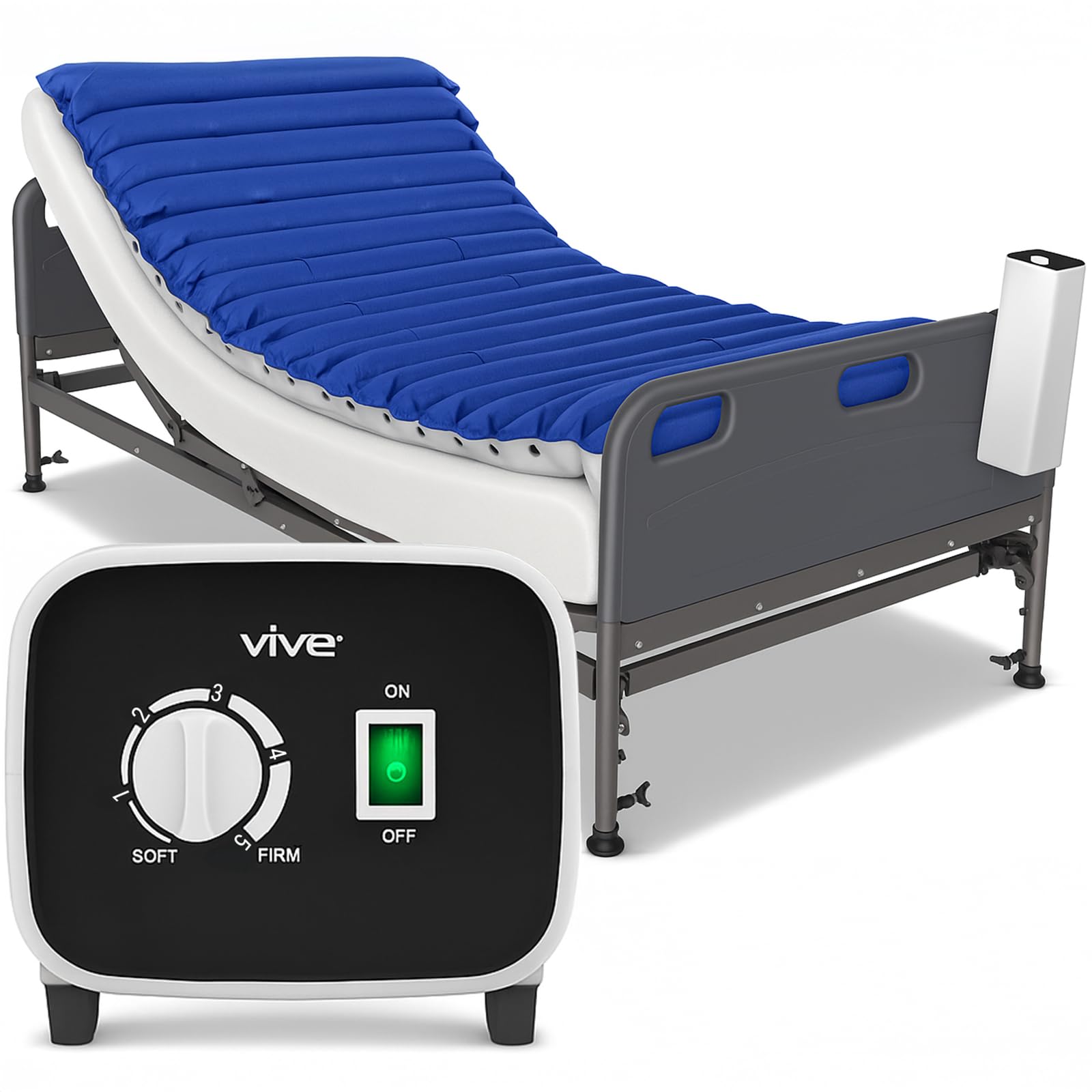
Cell count is the reason this 5-inch pad belongs on a shortlist. Sixteen sealed air chambers feed off a variable pressure pump, so the pressure map on the patient’s back changes in finer steps than a pad with fewer, fatter tubes. It measures 77″ x 34″ x 5″ and carries up to 300 pounds.
The pump hooks to the foot of the bed with two non-marking hooks and shows the current firmness on a dial, so a caregiver always knows what setting is running. Buyers rate bedsore prevention highest, then pump noise — the dial pump is built to run quietly overnight in a shared room. It is FSA/HSA eligible and backed by a 1 year guarantee.
The cover is latex-free waterproof vinyl and lets heat move off the patient. What splits opinion is the air pressure and stability, so check the top-row cells after the first inflation — a few report air not holding at the head of the bed. Comfort is fine for most, though a vinyl top runs warm for a sleeper who already sweats.
Standout spec: 16 sealed air chambers across a 77″ x 34″ x 5″ surface, with a dial pump that shows the setting and a latex-free waterproof cover.
Well matched if you want finer pressure steps across the back and health-account eligibility.
Second look needed if you need stronger support at the very top — check the head cells after inflating.
7. Vive 8″ Alternating Pressure Mattress

A full replacement mattress, not a topper — eight inches tall, low air loss, with a static pillow at the head.
This is a different class of device. Rather than a pad sitting on top of an existing mattress, the Vive 8-inch replaces the mattress on a hospital bed at 80″ x 34″ x 8″ and 24.2 pounds. Sixteen air chambers run off a variable pressure pump, and the three cells at the head stay static to form a pillow of air, so the head does not sink while the body cycles.
Low air loss means air escapes the surface to move heat and moisture away from the skin — a relief for a patient who spends all day in bed. Pressure is adjustable in both firmness and cycle frequency, with a static setting for general use. The waterproof vinyl cover over the cells wipes down, and the pump hangs off the foot of the bed on two non-marking hooks.
The trade-off that matters most is the pump. Some buyers report the original pump failing after a few months, and durability across the board is the split point on this one. Budget for the possibility of a replacement pump rather than assuming it runs indefinitely. Setup itself is straightforward, and buyers are largely happy with how it performs at preventing bedsores.
The replacement mattress argument
- 16 chambers with the 3 head cells static to keep the head lifted.
- Low air loss surface moves heat away from the skin.
- 80″ x 34″ x 8″ footprint fits standard hospital beds.
- Adjustable cycle frequency to match a care plan.
Where it can fall short
- Some pumps fail within a few months — plan for a replacement.
- It replaces the mattress, so it only fits a genuine hospital frame.
- Heavier to handle at 24.2 pounds when the bed needs moving.
Right for the full bed swap where a hospital frame already exists and a low air loss surface is the goal.
Know going in: pump durability is the weak spot — keep the receipt.
8. Drive Medical Med-Aire Low Air Loss Mattress
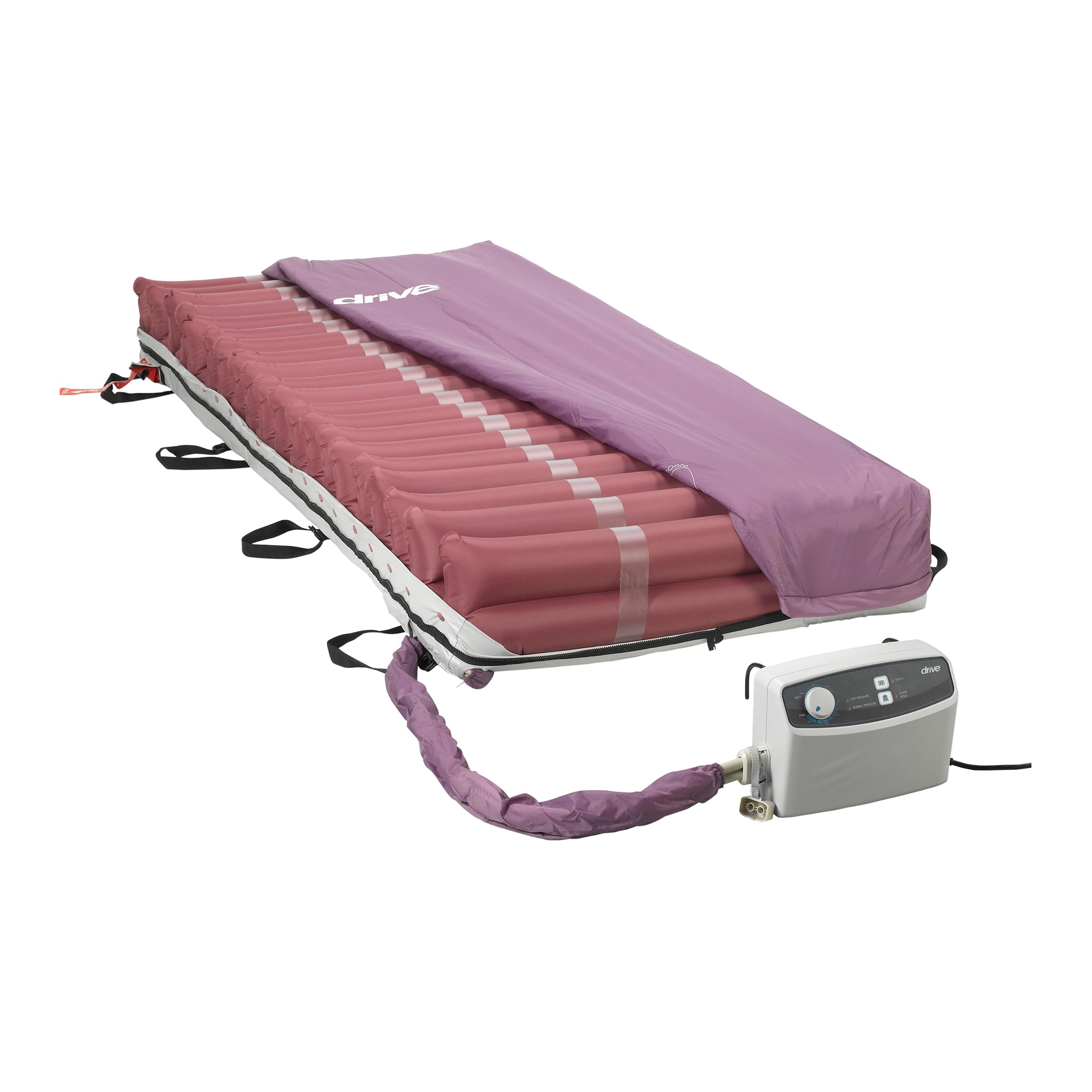
Twenty replaceable bladders and a pump that tells you when pressure drops, built for long-term care.
Repairability is the headliner. This system uses 20 individual 8-inch air bladders, each one replaceable on its own, so a single damaged cell does not take the whole mattress out of service. Low air loss ventilation moves heat and moisture off the patient, and a built-in pillow area holds the head steady. A vapor permeable cover adds shear friction reduction to cut down on moisture and friction across the skin.
The pump does more than inflate. An audio visual alarm and automatic pressure monitoring flag a low-pressure event so a caregiver knows when something is off, rather than discovering it hours later. That monitoring is the feature that pushes this toward institutional and long-term care settings where the bed is checked less often by a rotating staff.
Buyers highlight performance and easy setup, and the price-to-build ratio looks fair for the number of bladders. Watch for pump reading drift over months (the pressure reading slowly wandering). Check that the alarm does not stay silent when a bladder is unseated (knocked loose). Keep spares on hand so a swap is a two-minute job, not a scramble.
Built to be serviced: 20 replaceable 8-inch bladders, a built-in pillow, low air loss ventilation, and a pump with audio visual low-pressure alarms — the most maintainable system here.
Reach for this if the bed runs in a facility or a home where a single bladder failure cannot mean a whole new mattress.
Watch closely: test the low-pressure alarm at setup so it warns before a cell is fully flat.
9. KEUZ Alternating Air Pressure Mattress Pad
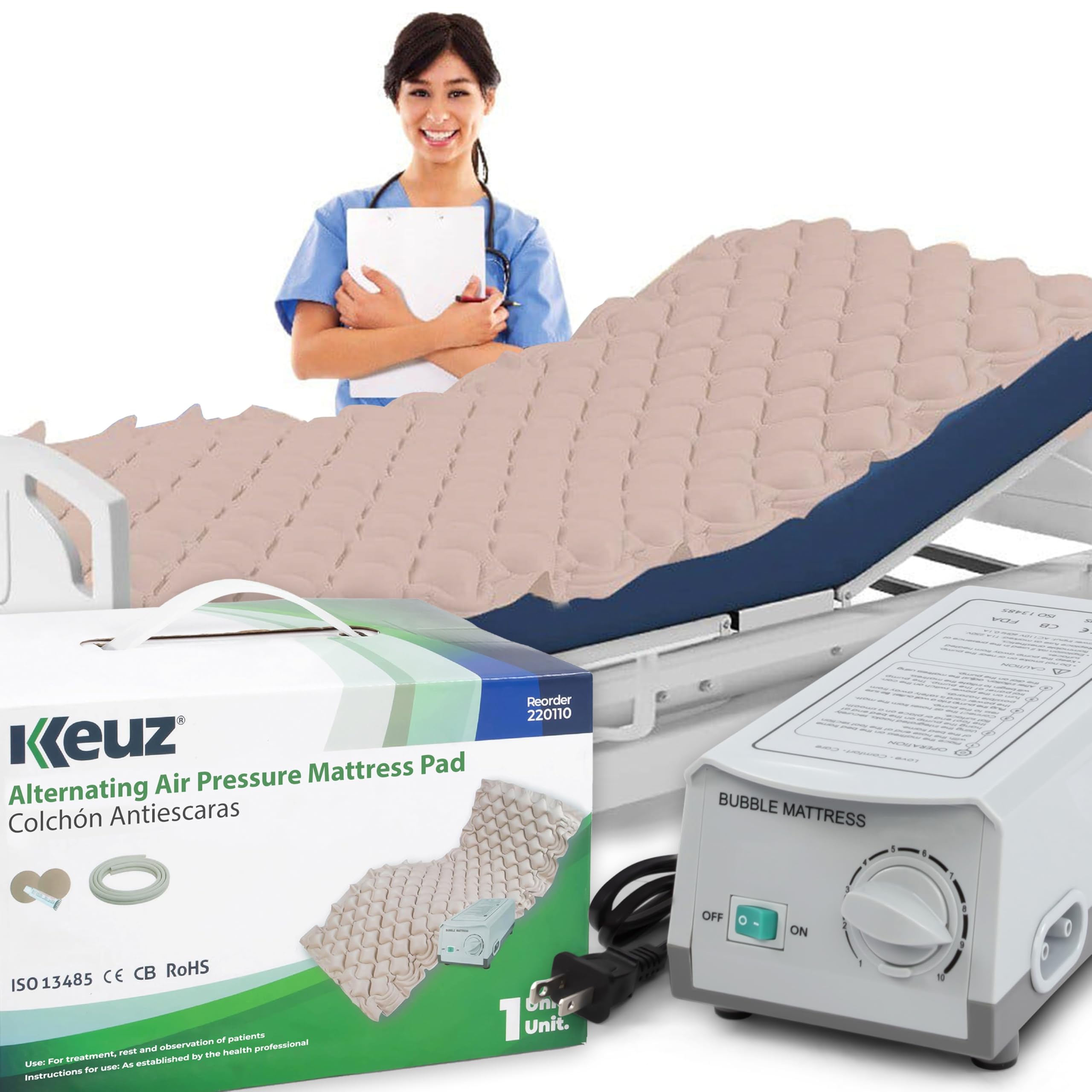
A repair kit ships in the box — the budget pad that plans for the puncture before it happens.
Most pads here leave you searching for a patch kit after the first snag. This one includes it, with patches for quick fixes so a small hole does not end the pad’s life. Its alternating cells cycle pressure across the back and hips to reduce bedsore risk, with no digital panel to set.
The pad measures 79″ x 35″ x 3″ without flaps, with 11″ x 5″ x 4″ extension flaps on both the top and bottom sides, so the whole thing anchors and stops sliding when the patient is turned. It holds up to 300 lbs and inflates and deflates automatically. Vinyl construction wipes clean, and the alternating pump keeps air pressure steady with minimal disruption. It is not recommended for recliners — a standard or hospital bed is where it belongs.
Matching the core function at the most accessible price is the entire pitch. What you give up is quiet-pump credentials and a cover upgrade: there is no published decibel rating here and the vinyl top runs warm. It is the pick for a backup pad, a short-term care situation, or a household that needs two and cannot stretch to a pair of premium units.
Value case: 79″ x 35″ pad, 300 lbs support, extension flaps top and bottom, and a repair kit included — the essentials without the extras.
Choose this when you need the alternating function covered at the most accessible tier and a patch kit is a comfort.
The give-up: no published decibel rating and a vinyl top that runs warm — pair it with a sheet.
Know the Specs
Alternating pressure cells
Rows of air cells that inflate and deflate in a cycle shift body weight from one point to the next. That constant movement is what distinguishes a bedsore prevention pad from a plain foam or static air topper. More chambers, like the 16 on the Vive 5-inch, divide that pressure in finer steps.
Low air loss
Low air loss means a small amount of air leaks through the surface to move heat and moisture away from skin. The Vive 8-inch and Drive Medical systems carry it, and it is the feature to look for when a patient spends all day in bed and skin stays damp.
Pump noise in decibels
The pump sits in the bedroom, so its rated loudness matters. The MedVance pump runs under 20 dB, the Lunderg pumps at 23 dBA, and the VOCIC ceramic pump at 45 dB. Quieter is better for a shared room; a louder pump is fine if it lives in a hallway.
Weight capacity
Capacity is the load the air cells carry before the body sinks through. Standard pads here support 300 lbs, with 320, 350, and 440 lbs at the higher end. Match the capacity to the person in the bed, not to a placeholder.
Static mode
Static mode stops the alternation and holds every cell fully inflated. That gives a firm, stable surface for transfers, repositioning, or a break from the cycling — a genuine caregiver aid, not a marketing extra.
Cover material
Vinyl and PVC wipe down easily but run warm, while flocked and nylon TPU surfaces breathe better against bare skin. Vinyl and PVC covers wipe clean but trap heat, while flocked and nylon TPU tops breathe against skin. A cotton sheet over the top helps either way.
Common Questions
Will an alternating pressure pad fit over my existing bed mattress?
Do I need a static mode or is alternating alone enough?
How loud is the pump if I sleep in the same room?
Does the pad come with a pump?
How quickly does a pad inflate?
What if the pad gets a hole?
Can I use an air mattress for pressure sores on a recliner?
Does a waterproof pad need a sheet over it?
How long will the pad and pump last?
Can I buy these with FSA or HSA funds?
The Bottom Line
The top pick among the air mattress for pressure sores is the MedVance. It pairs a pump rated under 20 dB (very quiet) with a quilted water-resistant anti-slip cover and a red-tag CPR deflate that empties the mattress within a second. If a stable static mode and a whisper-quiet 23 dBA pump (about as loud as a soft whisper) matter more than the CPR tag, reach for the Lunderg Alternating Air Pressure Pad. For a heavier user who needs 440 lbs of support, the VOCIC carries the most load on the list. The Drive Medical Med-Aire is the long-term choice: its 20 replaceable bladders mean one failure does not end the mattress. Most households start with the MedVance, the quietest pad here, and its fans keep returning to how little the pump disturbs a good night.
How we choose
We do not accept paid placement. Every pick is matched to a real buyer and a real use-case; we do not hands-on test units.
Sources
Specifications: manufacturer listings and product documentation. Review insights: verified customer reviews, as of November 2026. Pricing: not shown on this page (it changes often); check the current price via the retailer link.
As an Amazon Associate, Doctor Guide Online earns from qualifying purchases. This does not affect which products we feature.