
Specs are compiled from manufacturer listings and verified buyer reviews and can change over time — please confirm the key details on the product page before buying.
You want one small clip that tells you, in seconds, whether your blood is carrying enough oxygen — and you want that number to be trustworthy on a cold morning, on tired hands, and without a nurse standing over you. Most home oximeters do the same core job, so the real differences sit in three places: how well the sensor holds a reading when circulation is poor, how big the numbers are for older eyes, and whether the package arrives ready to use. Here is how the models below sort out on those three points.
This guide is built by comparing the manufacturers’ published specifications and the patterns across verified customer reviews, so you get each pick’s real strengths and trade-offs instead of marketing spin.
Below you will find the caliber of device that suits a nightstand, a gym bag, or a caregiver’s kit, sorted by what actually matters at home. Every pick here is a genuine fingertip oximeter, and the goal is simple: help you land on the best pulse oximeter for home use without second-guessing your choice.
Top Picks

How To Choose The Best Pulse Oximeter for Home Use
Most people assume a home oximeter either works or it doesn’t. In reality, the same device can read perfectly on a warm hand and fail on a cold one, because the sensor needs a steady pulse of blood under the light to do its job. So the smart way to shop is to look for the features that help it cope with real hands — cold, dry, painted, small, or shaky.
Look for the readings that tell you the number is solid
A basic oximeter shows two numbers: your SpO2 (the percentage of oxygen your red blood cells are carrying) and your pulse rate in beats per minute. Better units add a perfusion index (a number showing how strong the pulse signal is at your fingertip) and a plethysmograph (a small waveform that pulses with each heartbeat). Those two extras are your proof the reading is clean rather than a guess. When the waveform is steady, you can trust the number in front of you.
Match the finger chamber to the hands in your house
The finger chamber is the slot your finger slides into, and it is spring-loaded on most models so it grips a range of sizes. A device that grips too loosely lets light leak in and the reading wobbles. A device that grips too tightly is uncomfortable for a long check. If children over twelve or elderly hands with thin skin will use it, check that the maker states the ages it suits — several of the models below name a starting age of 12, and one names kids above four.
Decide how much memory and alerting you actually need
If you are checking once a day, a simple read-and-go display is plenty. If you are tracking a trend over a week, or checking someone overnight, a built-in memory that stores past readings and an audible alarm for out-of-range values becomes genuinely useful. The Wellue stores the last 12 readings; the Innovo and the iProven add alarm and rhythm tools. Pay for those only if you will use them.
Treat the carry case and battery type as part of the package
Nearly every model here runs on two AAA batteries, and most ship with them included, so the device works the moment you open the box. A protective case and a lanyard sound trivial until the device lives in a drawer or a bag. A hard case keeps dust off the sensor window, and dust on that window is one of the quiet reasons readings drift.
Side-by-Side Comparison
| Model | Best For | Stated Battery Life | SpO2 Accuracy | Measuring Range | Amazon |
|---|---|---|---|---|---|
| Innovo Deluxe iP900AP★ Best Overall | Daily home checks with alarm and waveform | 30 hours | +/-2% | 70% – 100% SpO2 | Amazon |
| Fingertip Pulse Oximeter (SpO2) with Pulse Bar GraphBest Display | Big red numbers and a full accessory kit | — | — | — | Amazon |
| Zacurate 500 Series (Royal Black)Most Reviewed | Widest finger fit and the largest owner base | 30 hours | +/-2% | SpO2: 70-100%, PR: 30-250 BPM | Amazon |
| Wellue Fingertip Oximeter (oxi 16) | Trend tracking with built-in memory | 24 hours | — | — | Amazon |
| Concord Deluxe OLED | Reading at any angle with a rotating display | Over 30 hours | — | — | Amazon |
| iProven OXI-27 | Respiratory rate and perfusion detail | 2 years | — | SpO2: 70-100%, PR: 30-255 bpm | Amazon |
| AccuMed CMS-50D1 | Long battery stretches and travel | Up to 32 hours | — | — | Amazon |
| WRINERY Oxygen Saturation Monitor | Sharp OLED readout in a compact shell | — | — | — | Amazon |
| Braun Fingertip Pulse Oximeter | Family use from age 12 up | — | — | — | Amazon |
Detailed Reviews
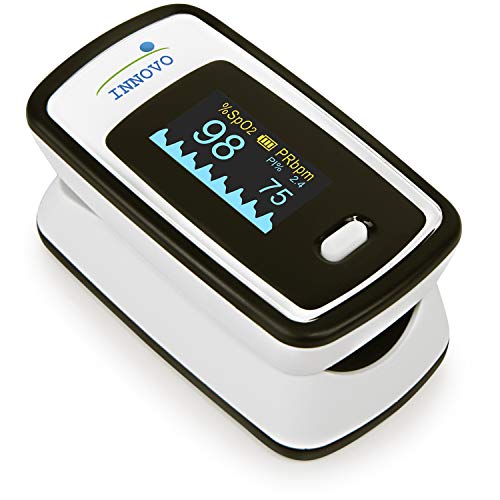
1. Innovo Deluxe iP900AP Fingertip Pulse Oximeter
Our pick — 4.5+★ from 51,000+ verified ratings; the strongest balance of quality and price.
The home oximeter that shows you the pulse signal, not just a bare number.
The iP900AP is the pick for anyone who wants to see the evidence behind a reading. Its upgraded LED and sensor are built to hold SpO2 (blood oxygen percentage) and pulse rate even when blood flow at the fingertip is low. That matters on cold mornings and for older hands, where a weaker signal is exactly what makes cheap oximeters wander.
Two readings do the explaining for you. The perfusion index tells you how strong the pulse signal is, and the plethysmograph draws a waveform that rises and falls with each beat. A steady waveform means a clean reading; a flat one tells you to warm your hand and try again. Pair that with the +/-2% stated accuracy and a 70%–100% SpO2 range, and you get a device honest about its own limits.
Its 30-hour battery figure matches the Zacurate’s 30 hours; the Wellue is rated at 24 hours. The alarm sounds when readings cross a limit, and the display brightness adjusts for a dim bedroom. The physical size is modest at 2.5″L x 1.35″W x 1.25″H, so it lives in a nightstand drawer without complaint. What earns it the top spot is the consistency of that signal readout — the thing that turns a single number into something you can actually trust.
What earns it the crown
- Perfusion index and plethysmograph waveform let you verify a reading before you trust it
- Audible alarm plus pulse-detection beeps flag out-of-range values for you
- 30-hour stated battery life on two included AAA batteries
- Adjustable display brightness suits a dark bedroom at night
- Stated +/-2% accuracy across a 70%–100% SpO2 range
What to weigh first
- Readings need a still hand — movement throws the waveform off
- Some units stop reporting after a short stretch; the long-run reliability picture is genuinely mixed
- No Bluetooth on this version, so nothing syncs to a phone
Reach for this if: you want the pulse-strength reading and waveform that tell you the number is real, plus an alarm for confidence overnight.
Look elsewhere if: you want your readings logged on a phone — this model carries no Bluetooth, and that is a deliberate hardware choice rather than a fault.
2. Fingertip Pulse Oximeter
For the reader who wants a bright red number that fills the screen.
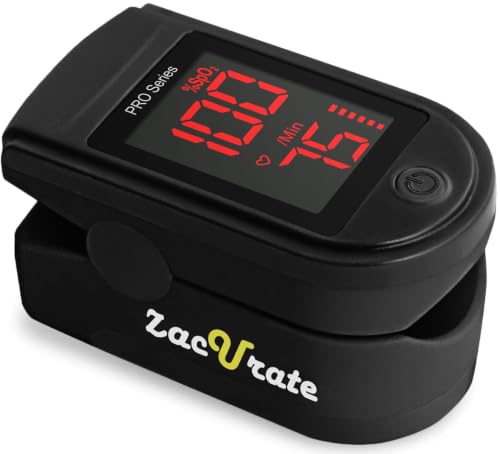
The large digital red LED display is the headline here — not a small detail, because reading a dim grey figure at arm’s length is exactly what trips up older eyes and tired caregivers. This device puts SpO2, pulse rate, and pulse strength on the screen in 8 to 10 seconds, and the bar graph gives you a quick visual sense of pulse strength alongside the numbers.
At 2.4 ounces, it slips into a bag without a second thought. The finger chamber uses latex-free silicone to grip a range of hand sizes, and the box includes the batteries, a protective case, and a neck/wrist cord — a full kit rather than a bare device.
What wins people over is the display’s clarity, and it is the most-discussed strength in the owner feedback. The honest trade-off is pace: readings sit in the 8-to-10-second window rather than being instant, and battery life draws a mixed reaction in the reviews. The bar graph and the clear red readout make it a strong choice for a household checking numbers together.
Readability focus: big red numbers on a clear display, with a bar graph that shows pulse strength at a glance — helpful when several people share one device and want a fast read.
Room to improve: the 8-to-10-second measurement window feels slower than some rivals, and the battery-life feedback is genuinely split, so keep spare AAA cells on hand.
Suits: a shared family device where the number needs to be readable from across a room.
Think twice if: you want an instant on-screen figure — this one takes a few seconds longer to settle.
3. Zacurate 500 Series Fingertip Pulse Oximeter (Royal Black)
The fingertip standard that nearly everyone seems to own or have tried.
If you want the device with the deepest pool of owner experience behind it, this is it — 4.5+ stars across a number in the hundreds of thousands. Its finger chamber uses a SMART Spring System to grip a wide range of hand sizes, and the maker states it suits ages 12 and above. That breadth is why it turns up in so many homes: one device, many hands.
Two specs separate it from the crowd. It is the only LED oximeter in this set that the maker says displays SpO2 up to 100%, and it reads from a 70%–100% SpO2 range with a pulse range of 30–250 BPM at a stated +/-2% accuracy. The display faces the user, so the number sits upright for you rather than upside down. It arrives with two AAA batteries, a silicone cover, and a lanyard, so it works right from the start.
The thing that wins people over is accuracy, and it is far and away the most-discussed strength here. The recurring gripe is reliability — a small share of units quit early — so buy from a seller with a clear return path. The Zacurate weighs 3.2 ounces. Its 30-hour stated battery life matches the Innovo’s 30 hours, and the Wellue is rated at 24 hours. With this many units in circulation, the odds heavily favor a good one.
The crowd favorite: a huge owner base, a spring-loaded chamber that adapts to more finger sizes, and a full kit including batteries, cover, and lanyard.
One caution to note: reliability is the honest weak spot — a minority of units stop reporting, so keep the warranty and return window in mind when it arrives.
Choose this for: a proven all-rounder that costs little more than a bare-bones unit and fits a wide range of hands.
skip it if: you cannot tolerate any chance of a dud — the reliability track record is the one thing to accept going in.
4. Wellue Fingertip Pulse Oximeter (oxi 16)

A memory bank in your pocket — the last twelve reads, one click away.
This is the device for someone watching a trend rather than grabbing a single number. It stores up to 12 groups of oxygen and pulse data in a record list, so you can flip back through your last twelve checks with one click. For anyone logging readings through a recovery week, that beats scribbling numbers on a notepad.
It measures in 8 seconds and powers on and off by itself, and a spot-check mode shows a pulse rhythm analysis after 30 seconds of measuring. The alert system is simple but practical: set a limit and the unit beeps and flashes the value when you cross it. It ships with two AAA batteries, a carry pouch, and a lanyard.
Two honest notes before you buy. First, the maker states this is not a medical device — it is sold for sports and aviation use — so treat it as a wellness tracker, not a diagnostic tool. Second, the beeping is the one thing owners split on, and the battery figure is 24 hours, versus 30 hours for the Innovo and 30 hours for the Zacurate. The core function is solid, but the 12-reading memory is the reason to pick it.
Why it earns a spot
- Built-in memory stores up to 12 past oxygen and pulse readings
- Spot-check pulse rhythm analysis after 30 seconds
- Beeps and flashes when a value exceeds your set limit
- 8-second measurement with automatic power on and off
The trade-offs to accept
- 24-hour stated battery life is the shortest here
- The beeping is a love-it-or-mute-it feature
- Sold for sports and aviation use, not as a medical device
Best fit: anyone tracking oxygen trends day to day who wants the last dozen readings stored on the device itself.
Weigh this first: if a beeping alarm would annoy you, the same memory can be had without living with a noisy reminder.
5. Concord Deluxe OLED Pulse Oximeter (Sapphire Blue)

Around three-quarters of an ounce of oximeter that turns to meet your eyes.
At 1.6 ounces, the Concord is a lightweight unit; the Zacurate is 3.2 ounces and the bar-graph model above is 2.4 ounces. That featherweight feel is paired with a rotating display that lets you read from more than one angle, which helps when you are checking someone else’s hand and cannot get your head in line with the screen.
It runs on a single button, gives you SpO2, pulse rate, and pulse strength, and switches itself off 8 seconds after your finger leaves the chamber. The maker states over 30 hours of continuous use on two AAA batteries, plus a 2-year warranty and USA-based technical support. The package includes the batteries, a carrying case, a lanyard, and a shock-resistant silicone cover.
Accuracy is what wins people over here — readings that line up with the professional units caregivers already know. The honest caveat is that durability gets mixed feedback, so treat the case as essential rather than optional. This is a compact, light device for a bag or a bedside table where the number needs to be legible from any angle.
Light and legible: 1.6 ounces with a rotating display, so it fits a small pocket and reads from more than one direction.
The caveat: durability draws split feedback, and the OLED readout needs a moment of stillness to settle.
Good match for: a caregiver checking someone else’s hand, where a display that turns toward you makes all the difference.
One thing to know: keep the included shock-resistant cover on — durability is the part of this device that needs looking after.
6. iProven OXI-27 Pulse Oximeter Fingertip
The only home oximeter here that counts your breaths as well as your beats.
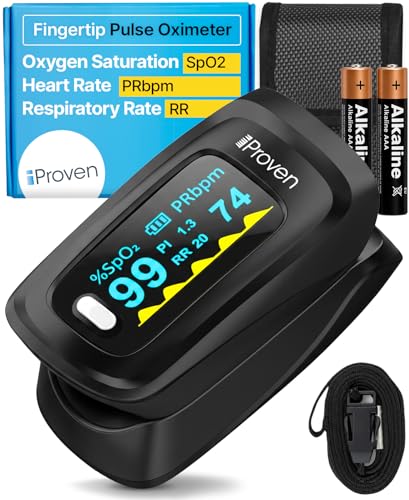
Most oximeters give you oxygen and pulse and stop there. The OXI-27 adds respiratory rate — your breaths per minute — displayed after 60+ seconds of measuring. If you are doing breathing exercises, relaxation routines, or daily wellness checks, that extra figure rounds out the picture in a way the others here simply cannot.
It also shows a perfusion index (pulse strength at the fingertip) and a plethysmograph waveform for real-time visual feedback of your pulse signal. Readings land in under 10 seconds, within a stated SpO2 range of 70%–100% and a pulse range of 30–255 bpm. The unit powers off 10 seconds after you remove your finger to stretch the batteries, and the stated battery life runs to 2 years, while the other models state battery life in hours. It comes with a 100-day full replacement policy.
What works for buyers is straightforward: it does the job for adults and children alike and returns quick readings. The honest catch is time — the respiratory feature needs 60+ seconds to complete, so it is not the device for a five-second glance. For anyone who wants respiratory rate and perfusion detail alongside SpO2 and pulse, it earns its place.
What makes it distinct
- Respiratory rate tracking shows breaths per minute
- Perfusion index and plethysmograph give signal detail
- Stated 2-year battery life on two AAA batteries
- 100-day full replacement policy backs it up
What to be aware of
- Respiratory rate takes 60+ seconds to display
- More readings on screen means a busier display to learn
Worth it for: anyone who wants breathing rate and pulse-strength detail alongside standard oxygen readings.
Not for you if: you want the simplest possible two-number screen — this one offers more, and asks a little more of you.
7. AccuMed CMS-50D1 Fingertip Pulse Oximeter

Up to 32 hours of battery and a display that flips to suit your hand.
If you hate the surprise of a dead battery, the AccuMed runs up to 32 continuous hours on two AAA cells, versus 30 hours for the Innovo and Zacurate and 24 hours for the Wellue. It also powers itself off when idle, so it is not quietly draining in your drawer. At 50 grams it disappears into a gym bag, and the included travel case keeps scratches off it.
The display auto-rotates between portrait and landscape by detecting your hand movement, so the number stays upright however you hold it. It measures oxygen and pulse in 8 to 10 seconds and fits fingers of kids above four through adults. The maker is clear that you must hold still for a precise reading — movement is the enemy of a clean signal on every oximeter, and this one says so outright.
Response speed is the one split verdict here; the readings come fast for some hands and slow for others depending on circulation. The rotating display and the long battery stretch are the practical earns. For travel and exercise, having a device that reads from either orientation without fiddling is a real convenience.
The long-haul choice: up to 32 hours of battery and an auto-rotating display, matched with a travel case and lanyard for bags and trips.
Be ready for: some readings come quickly and some take longer, so a still, warm hand is worth more than a rushed one.
Pairs well with: travel, hiking, and aviation where the display should read at any angle and the battery should not quit mid-trip.
A fair caution: the reading speed varies by hand, so give it a settled finger rather than a moving one.
8. WRINERY Oxygen Saturation Monitor (Silver-White)

A vivid OLED screen that makes the numbers crisp, even in a dim room.
The WRINERY’s selling point is its updated high-definition OLED display — sharp, bright digits that stand out rather than a washed-out grey readout. It measures your oxygen level and pulse rate within 8 seconds, and the finger chamber accommodates a wide range of hand sizes from younger users to elders.
The kit is complete without extras to buy: the oximeter, a protective case, a hook, a lanyard, two AAA batteries, and a user manual. The maker states it is not for medical use and is intended for home oxygen monitoring, sports, and aviation, so treat it as a wellness device. Hold still while it measures for the most accurate reading.
Accuracy is the strength that wins people over, with readings that line up closely with what a doctor’s office shows. The brand is newer to this space than the well-known names here, so parts of its track record are still building. It is a compact, sharp-screened pick for someone who values a clear display over a familiar label.
Screen-first design: an OLED readout with sharp digits and an 8-second measurement, backed by a full accessory set including case, lanyard, and batteries.
The catch: sold for home, sports, and aviation use only, not as a medical device, and the brand lacks the deep owner history of the bigger names.
Pick it for: a crisp, easy-to-read OLED screen in a compact body for everyday home and travel checks.
Pass it up if: you want a device with decades of owner feedback behind it — this one is newer to the field.
9. Braun Fingertip Pulse Oximeter

The trusted name on the thermometer shelf, now for oxygen readings.
The Braun brings a familiar household brand name into the oximeter drawer. It features a simple finger clip, a push button, and a backlit OLED display, and it can be used for adults and as a pediatric oximeter for children 12 and older. If you already trust Braun for the family’s thermometers, keeping the same brand across the home health kit has a certain reassurance to it.
Braun states clinically validated accuracy, with readings presented as quick, reliable, and consistent. It reads blood oxygen levels, which Braun describes as an important indicator of respiratory health. Braun’s pediatrician endorsements reflect the brand’s wider standing, not a claim about this device’s clinical validation.
Where this pick needs a caveat is track record — it is the newest entry in this lineup and the owner feedback pool is still growing. For a household that wants a simple, well-labeled device from a name it already knows, it makes sense; for a buyer who wants deep owner history, the bigger picks up top deliver that.
Brand familiarity: a simple finger clip, backlit OLED display, and a starting age of 12 for family use.
What is still unproven: it is the newest device here and has far less owner feedback than the established picks.
Best for: a household already using Braun products that wants one consistent brand across the health kit.
Consider the established picks instead if: a long, deep record of owner experience matters more to you than a familiar label.
Know the Specs
SpO2 accuracy and measuring range
SpO2 is the percentage of oxygen your red blood cells are carrying, and the stated accuracy figure — such as +/-2% — is how close the device’s number typically sits to a lab reference. A tighter stated figure means less guesswork. The measuring range — such as 70%–100% — tells you the span the maker promises readings across. Most consumer models claim the full 70%–100% band, so the accuracy claim is the more useful differentiator when you compare devices.
Perfusion index and plethysmograph
The perfusion index is a number showing how strong the pulse signal is at your fingertip, and the plethysmograph is a small waveform that pulses with each heartbeat. Together they tell you whether the reading in front of you is clean. A steady waveform and a healthy perfusion figure mean the sensor has a solid signal and the number is worth trusting; a flat waveform means your hand needs warming or stilling. These two features are why the top picks here give you more confidence than a bare two-number display.
Battery life and power
Nearly every device here runs on two AAA batteries, and most ship with them included. Stated life varies widely — from 24 hours up to 32 continuous hours on some models, while one maker states battery life in years rather than hours. If you check daily, the hours-based figures stretch comfortably; if you only check occasionally, the promised replacement interval matters more. Check that the batteries are included, or you will be hunting for cells on day one.
Finger fit and display angle
The finger chamber is the slot your finger slides into, and a spring-loaded grip keeps light from leaking in, which protects the reading. A model that fits a wide range of hand sizes, or states a starting age, is easier to share across a family. The display angle matters too: some devices face the number toward you, and some rotate so you can read it from more than one direction. For a caregiver checking someone else’s hand, that rotating or user-facing display is a real convenience.
Common Questions
What SpO2 reading should worry me at home?
Why does my oximeter sometimes fail to give a reading?
Is a fingertip oximeter a medical device I can rely on for diagnosis?
Do these oximeters work on children?
What is the perfusion index and do I need it?
How long do the batteries last and what type do they take?
Does holding still really matter for an accurate reading?
Is a rotating or backlit display worth having at home?
Do I need memory or an alarm on a home oximeter?
The Bottom Line
The best pulse oximeter for home use depends on how much reassurance you want on screen. For most people, the Innovo Deluxe iP900AP wins because its perfusion index (a measure of blood flow at the sensor) and waveform show you the reading is real — that is the feature that separates a trustworthy number from a guess. If you want the deepest pool of owner experience and the widest finger fit, the Zacurate 500 Series is the proven all-rounder, and its reliability is the one thing to weigh. And for tracking a trend with the last twelve readings stored on the device, the Wellue oxi 16 is the one to reach for. Whichever you pick, a warm, still hand is what makes any oximeter read true.
How we choose
We do not accept paid placement. Every pick is matched to a real buyer and a real use-case; we do not hands-on test units.
Sources
Specifications: manufacturer listings and product documentation. Review insights: verified customer reviews, as of November 2026. Pricing: not shown on this page (it changes often); check the current price via the retailer link.
As an Amazon Associate, Doctor Guide Online earns from qualifying purchases. This does not affect which products we feature.