
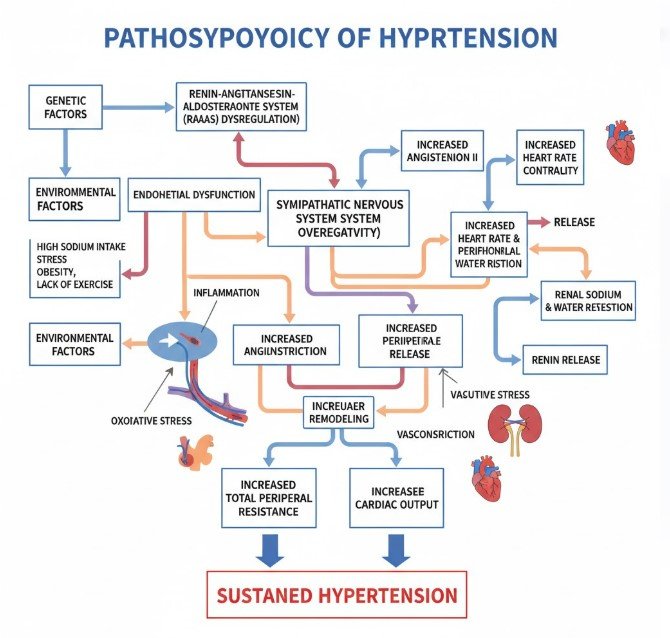
If you’ve ever felt your heart pounding after climbing stairs or during stress, you’ve experienced your body’s natural blood pressure rise. But when this pressure stays high all the time, it becomes something far more serious—hypertension. It’s often called the “silent killer” because you can live with it for years without feeling anything unusual, while it quietly damages your heart, kidneys, and blood vessels.
Understanding the pathophysiology of hypertension isn’t just for doctors or medical students. It helps everyone recognize how this condition develops, what keeps it going, and how it can be controlled. In this article, we’ll explore the biological mechanisms, risk factors, and body systems involved in hypertension in simple, friendly language—like we’re talking over a cup of tea about how our bodies really work.
Before diving deeper, here are a few key points we’ll cover:
-
How the body normally controls blood pressure.
-
What goes wrong in hypertension.
-
The roles of hormones, kidneys, and blood vessels.
-
How genetics and lifestyle influence it.
-
Why understanding the pathophysiology of hypertension is key to prevention and treatment.
What Is Hypertension and Why Does It Matter?
Hypertension, or high blood pressure, happens when the force of blood against the artery walls remains consistently elevated. Normally, the heart pumps blood through arteries with just enough pressure to deliver oxygen and nutrients. When this pressure stays too high, arteries become damaged, the heart works harder, and major organs—like the brain and kidneys—start to suffer.
Blood pressure is measured in millimeters of mercury (mmHg) and has two numbers:
-
Systolic pressure (the top number) shows how hard the heart pumps.
-
Diastolic pressure (the bottom number) shows the pressure when the heart relaxes.
A healthy reading is around 120/80 mmHg, but readings consistently above 130/80 mmHg usually indicate hypertension.
The pathophysiology of hypertension helps us understand why this happens. It’s not just about having thick blood or stiff arteries—it’s about how multiple systems of the body lose their balance over time.
Normal Blood Pressure Regulation: The Body’s Balancing Act
Before we understand what goes wrong, let’s look at how the body normally keeps blood pressure in check. The body is designed with an incredible balancing system called homeostasis. This system works like a thermostat, adjusting blood flow and vessel resistance as needed.
Here’s how it works:
-
The autonomic nervous system controls heart rate and vessel constriction.
-
The kidneys regulate blood volume by managing how much sodium and water are excreted.
-
The renin-angiotensin-aldosterone system (RAAS) adjusts fluid balance and vascular tone.
-
The baroreceptor reflex, found in the arteries, detects changes in pressure and sends signals to stabilize it.
When all these systems work smoothly, blood pressure stays within a healthy range. But when one or more go off balance, hypertension begins to develop.
Let’s take a look at this process step by step in the pathophysiology of hypertension.
The Role of the Renin-Angiotensin-Aldosterone System (RAAS)
One of the most critical players in the pathophysiology of hypertension is the RAAS system. It acts like a hormonal chain reaction that controls blood volume and vessel constriction.
When your blood pressure drops or your body senses low sodium, your kidneys release renin. This enzyme converts angiotensinogen (from the liver) into angiotensin I, which is then turned into angiotensin II by an enzyme in the lungs called ACE (angiotensin-converting enzyme).
Now here’s the key part: angiotensin II is a powerful vasoconstrictor—it narrows the blood vessels, which increases blood pressure. It also tells the adrenal glands to release aldosterone, a hormone that makes your kidneys hold on to sodium and water, raising blood volume and, in turn, pressure.
If this system stays overactive, it leads to chronic high blood pressure. Many medications for hypertension, such as ACE inhibitors or angiotensin receptor blockers (ARBs), work by calming down this system.
Sympathetic Nervous System Overactivity: When the Body Stays on Alert
Another major contributor to the pathophysiology of hypertension is sympathetic nervous system (SNS) overactivity. Think of this as your body’s “fight or flight” mode being turned on too often.
In stressful situations, the SNS increases heart rate and tightens blood vessels to prepare your body for action. That’s fine for short bursts—but when the SNS is constantly stimulated by stress, poor sleep, smoking, or certain diseases, the body starts to stay in a state of chronic tension.
This leads to:
-
Increased cardiac output (how much blood the heart pumps).
-
Constricted blood vessels (raising resistance).
-
Elevated renin release, activating the RAAS system.
Over time, these combined effects cause long-term elevation in blood pressure. It’s like driving a car with the engine revving too high all the time—eventually, something breaks down.
Vascular Remodeling and Endothelial Dysfunction
Over time, high pressure in the arteries changes their structure. This process, known as vascular remodeling, is another vital concept in the pathophysiology of hypertension.
Healthy arteries are flexible and elastic, allowing blood to flow smoothly. But when exposed to constant high pressure, the endothelium—the thin inner lining of the vessels—gets damaged. Once that happens, the arteries become thicker, stiffer, and less responsive.
The endothelial cells normally release nitric oxide (NO), a molecule that helps relax blood vessels. In hypertension, the production of NO decreases while harmful substances like endothelin increase, leading to endothelial dysfunction. This makes it harder for blood vessels to dilate, causing even higher pressure.
Here’s a simple comparison table to understand it better:
| Function | Healthy Artery | Hypertensive Artery |
|---|---|---|
| Elasticity | High | Low |
| Nitric Oxide | Normal | Reduced |
| Endothelin | Low | Elevated |
| Blood Flow | Smooth | Restricted |
| Inflammation | Minimal | Increased |
This cycle of damage and stiffness creates a self-perpetuating loop, keeping blood pressure high and increasing the risk of heart attack, stroke, and kidney disease.
The Role of the Kidneys in Hypertension
The kidneys act as natural filters, but in the pathophysiology of hypertension, they become both victims and contributors.
Normally, kidneys regulate sodium, water, and blood volume. But when they sense reduced blood flow—often due to vascular narrowing—they release renin, which activates the RAAS system. This leads to sodium retention and higher fluid volume, raising pressure even more.
In chronic hypertension, this overactivity damages the kidney’s small arteries, leading to nephrosclerosis (hardening of kidney vessels). This reduces filtration ability and worsens blood pressure control, forming a vicious cycle.
A simple way to imagine it: your kidneys are like sponges trying to balance water levels. But if they’re constantly squeezed by high pressure, they can’t function properly, causing even more fluid buildup.
Genetic and Environmental Factors in Hypertension
Hypertension doesn’t come from one single cause—it’s a complex interaction of genes and environment. In the pathophysiology of hypertension, certain genetic factors make some people more sensitive to sodium or more prone to overactive hormonal systems.
For instance, if your parents had hypertension, your risk is higher. But genes alone don’t tell the full story. Lifestyle factors like diet, stress, alcohol, and lack of exercise play an equally big role.
Here’s how both sides interact:
-
Genetic predisposition → affects kidney function and vascular tone.
-
Environmental factors → like salt intake, obesity, and stress, trigger these genetic tendencies.
So while you can’t change your genes, you can absolutely manage your environment—and that’s where lifestyle modification becomes powerful.
Hormonal Influences and the Endocrine Connection
Our hormones quietly influence almost every aspect of health, and in the pathophysiology of hypertension, their role is significant. Hormones like aldosterone, cortisol, adrenaline, and noradrenaline all interact with the cardiovascular system.
-
Aldosterone retains sodium and water.
-
Cortisol (stress hormone) can enhance vascular sensitivity to other hormones.
-
Adrenaline and noradrenaline raise heart rate and vessel tone.
When these hormones are constantly elevated—due to stress, endocrine disorders, or metabolic imbalance—they keep the blood pressure elevated. Conditions like Cushing’s syndrome or hyperaldosteronism often cause secondary hypertension through these mechanisms.
In simple terms, imagine your hormones as background music for your body. When it’s calm and rhythmic, everything feels balanced. But if it turns into nonstop heavy metal, your system can’t relax—and that’s what happens in hormonal hypertension.
Inflammation and Oxidative Stress: The Hidden Triggers
When people think of high blood pressure, they often imagine stress or too much salt. But deep inside the body, two silent processes—inflammation and oxidative stress—play a big role in the pathophysiology of hypertension.
Inflammation is the body’s natural defense mechanism. However, when it becomes chronic, it damages blood vessels. The endothelium, which keeps arteries healthy, starts producing inflammatory molecules like C-reactive protein (CRP) and cytokines. These chemicals attract immune cells that make the vessel walls thicker and less elastic.
At the same time, oxidative stress—caused by excess free radicals—further injures the endothelium. It reduces nitric oxide (NO), the molecule that relaxes blood vessels. Without enough NO, arteries remain tight and pressure rises.
In simple terms, think of oxidative stress as “rust” forming inside your blood vessels. Just like rust weakens metal, oxidative stress weakens arteries, making them more prone to stiffness and blockages.
Eating antioxidant-rich foods like fruits, vegetables, and green tea can help reduce this internal rusting, indirectly protecting you from hypertension’s deeper damage.
Microcirculation and Tissue-Level Changes
Another fascinating layer of the pathophysiology of hypertension involves microcirculation, the flow of blood through tiny vessels that nourish tissues.
When blood pressure remains high for a long time, these small vessels—especially in the brain, eyes, and kidneys—undergo structural changes. They narrow, thicken, and sometimes even close off. This restricts oxygen and nutrient delivery, leading to damage at the tissue level.
For example:
-
In the brain, this can cause mini-strokes or cognitive decline.
-
In the eyes, it may lead to hypertensive retinopathy, blurring vision.
-
In the kidneys, it results in reduced filtration and chronic kidney disease.
These microvascular changes often appear long before major symptoms show up. That’s why regular checkups, even when you feel fine, are so important. Early detection can prevent years of silent damage.
Primary vs. Secondary Hypertension: Understanding the Difference
Not all hypertension is the same, and understanding this distinction is crucial in grasping the pathophysiology of hypertension.
-
Primary (Essential) Hypertension:
This is the most common type, accounting for about 90–95% of all cases. It develops gradually over time and doesn’t have a single identifiable cause. Instead, it results from a combination of genetic, environmental, and lifestyle factors that disturb normal pressure regulation. -
Secondary Hypertension:
This form has a clear underlying cause—like kidney disease, hormonal imbalance, or certain medications. Once the cause is treated, the blood pressure often returns to normal.
| Feature | Primary Hypertension | Secondary Hypertension |
|---|---|---|
| Cause | Multifactorial (genetic + lifestyle) | Specific underlying disease |
| Onset | Gradual | Sudden or early |
| Reversibility | Usually lifelong management | Often reversible |
| Examples | Essential hypertension | Renal artery stenosis, Cushing’s syndrome, hyperthyroidism |
Knowing which type you have helps doctors choose the right treatment. It’s like identifying whether a leaky roof is due to a heavy storm or a single broken tile—you fix the problem differently in each case.
Target Organ Damage: The End Results of Uncontrolled Pressure
Hypertension doesn’t stay confined to the arteries. Over time, the constant high pressure affects multiple organs, a concept central to the pathophysiology of hypertension.
Heart:
The heart has to pump harder against increased resistance. This leads to left ventricular hypertrophy (thickening of the heart muscle), which eventually causes heart failure or arrhythmias.
Brain:
Chronic high pressure weakens blood vessels, making them prone to rupture or blockage—resulting in stroke or transient ischemic attacks (TIAs).
Kidneys:
As mentioned earlier, the kidneys suffer from nephrosclerosis, leading to chronic kidney disease (CKD).
Eyes:
Tiny vessels in the retina can burst or thicken, leading to retinopathy and vision loss.
Peripheral Arteries:
Reduced circulation in the limbs can cause pain, ulcers, and poor wound healing, a condition known as peripheral artery disease (PAD).
Once these organs are affected, hypertension is no longer just a number—it becomes a multi-systemic threat that needs serious management.
Lifestyle, Diet, and the Modifiable Pathophysiology
While genes and hormones play their part, lifestyle remains one of the most powerful factors in shaping the pathophysiology of hypertension.
High salt intake, sedentary living, excessive alcohol, and chronic stress can all disturb the body’s natural balance. These factors increase vascular resistance, stimulate the sympathetic nervous system, and overload the kidneys.
The good news? The opposite is also true. Simple changes can help restore balance:
-
Reduce salt and processed foods to decrease water retention.
-
Stay active to strengthen your heart and improve vessel elasticity.
-
Manage stress with meditation, deep breathing, or time in nature.
-
Eat potassium-rich foods like bananas and spinach to counter sodium’s effects.
By adjusting these habits, you’re not just treating the symptoms—you’re addressing the deeper physiological causes of hypertension.
How Aging and Gender Influence Hypertension
Age is one factor no one can escape, and it’s deeply tied to the pathophysiology of hypertension. As we age, arteries naturally lose elasticity and become stiffer. This reduces their ability to expand when the heart pumps blood, causing systolic pressure to rise.
Hormonal changes also play a role. For example, estrogen in premenopausal women helps protect blood vessels. But after menopause, when estrogen levels drop, the risk of hypertension increases sharply.
In men, earlier onset of hypertension is more common, partly due to higher levels of stress hormones and lifestyle differences. However, after age 60, women often catch up or even surpass men in hypertension prevalence.
Understanding these natural changes helps people of every age take proactive steps to protect their heart and arteries.
Prevention and Early Intervention: Breaking the Cycle
The good thing about understanding the pathophysiology of hypertension is that knowledge gives you power—the power to prevent it.
Here are key steps to break the cycle early:
-
Check your blood pressure regularly, even if you feel fine.
-
Avoid smoking, as it damages blood vessels.
-
Eat more fresh produce and cut down on sugar.
-
Sleep well, because poor rest increases sympathetic activity.
-
Keep stress in check—mental calmness truly supports heart health.
These aren’t just lifestyle tips—they’re preventive tools grounded in science. Each healthy habit directly influences the systems that regulate blood pressure, such as the kidneys, hormones, and nervous system.
Summary: Bringing It All Together
To sum up, the pathophysiology of hypertension is like a chain reaction that starts quietly and spreads widely. It involves the nervous system, hormones, kidneys, blood vessels, and inflammatory processes all interacting in complex ways.
When one system falters—say, the kidneys retain too much sodium or the vessels lose elasticity—others compensate, often leading to a vicious cycle of rising pressure.
Understanding this interconnected web helps explain why managing hypertension isn’t just about taking medication. It’s about balancing your lifestyle, reducing stress, eating right, and staying active—because all these directly influence the underlying biology of blood pressure control.
Frequently Asked Questions (FAQs)
1. What is the main cause of hypertension?
The pathophysiology of hypertension is complex and usually involves multiple factors. In most cases, it’s a mix of genetics, poor diet, inactivity, stress, and overactive hormonal systems rather than one single cause.
2. How do the kidneys contribute to hypertension?
The kidneys control blood pressure by managing fluid and sodium balance. When they hold on to too much sodium or sense low flow, they release renin, which triggers the RAAS system, raising blood pressure.
3. Can stress really cause high blood pressure?
Yes. Chronic stress keeps your sympathetic nervous system activated, raising heart rate and narrowing vessels. Over time, this constant “fight or flight” mode can lead to sustained hypertension.
4. What’s the difference between primary and secondary hypertension?
Primary hypertension has no specific cause and develops over time, while secondary hypertension results from identifiable conditions like kidney disease or hormonal disorders.
5. Can hypertension be cured?
While primary hypertension usually can’t be completely cured, it can be effectively controlled with lifestyle changes and medications. Secondary hypertension can often be reversed by treating the root cause.
6. Why is hypertension called the “silent killer”?
Because it rarely causes symptoms until it has already damaged vital organs like the heart, kidneys, or brain. That’s why routine monitoring is so important.
7. Does diet really make a difference?
Absolutely. A diet high in salt, sugar, and processed food increases fluid retention and vessel stiffness. A balanced diet with fruits, vegetables, and whole grains helps maintain normal pressure.
8. How can I naturally reduce my blood pressure?
You can manage it naturally through regular exercise, reducing sodium, quitting smoking, managing stress, and eating heart-healthy foods rich in potassium and antioxidants.
Final Thoughts
The pathophysiology of hypertension reveals just how interconnected our body truly is. Every heartbeat, hormone, and vessel plays a part in this delicate balance. By understanding what happens inside us, we can make smarter choices outside—choices that protect our heart, extend our lifespan, and enhance our well-being.
Hypertension may be common, but it’s not inevitable. Knowledge, awareness, and consistent care can keep this silent threat from ever becoming a reality in your life.